
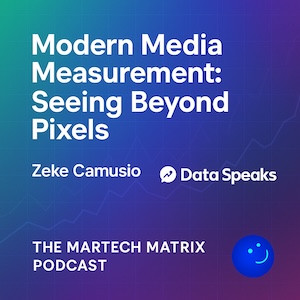
In this episode of The MarTech Matrix, Sean Simon sits down with Zeke Camusio, founder of Data Speaks, to unpack why marketers have been “flying blind” for years—and how modern media measurement is finally giving them clarity. Zeke explains why pixels fall short, what makes marketing mix modeling (MMM) relevant again, and how combining MMM, incrementality testing, and multi-touch attribution helps brands uncover the truth about their media performance.
Listen and Subscribe from Your Favorite Podcast Platform

Takeaways
- Pixels are broken. Nearly half of online conversions (42%) go untracked due to blockers, privacy settings, and attribution window limitations.
- Sales aren’t just on your site. 40% of eCommerce sales happen off-site (Amazon, Walmart, marketplaces), invisible to pixel tracking.
- Ad spend leakage. 17% of spend goes into channels like audio and TV that pixels can’t measure, leaving major blind spots.
- Last click is lazy. It oversimplifies the customer journey, rewarding the final step and ignoring the true path to purchase.
- Duplication is rampant. Multiple platforms often claim credit for the same conversion, inflating perceived ROI.
- MMM is back. Once considered slow and outdated, modern MMM now runs weekly, giving marketers near real-time budget insights.
- Unified framework matters. Combining MMM, incrementality testing, and MTA gives the clearest picture of channel performance.
- Custom > generic. AI-powered custom models now outperform generic off-the-shelf ones—at similar cost—thanks to automation.
- 36% of ad dollars are wasted. Bad data and poor measurement account for over a third of spend, creating a massive opportunity for optimization.
- Experimentation wins. The best way to break through opinion vs. opinion debates is to run structured tests and let the data speak.
Chapters
Intro & Sponsor Shoutout (00:01–00:44) Sean introduces the theme: why marketers have been “flying blind” and how better measurement restores vision.
Meet Zeke Camusio (00:44–02:10) Zeke shares his background as an entrepreneur and why he founded Data Speaks after seeing marketers’ frustration with measurement.
The Problem with Pixels (02:10–03:47) Why current attribution methods fall short: off-site sales, blocked conversions, arbitrary attribution windows, and duplication.
The Measurement Framework (04:19–05:38) Zeke explains the three pillars: MMM, incrementality testing, and MTA—and why they work best together.
MMM Misconceptions (05:38–06:25) Why MMM is misunderstood, how it’s evolved, and why it’s valuable in a real-time, digital-first environment.
The Trouble with Last Click (06:25–08:30) Why simplistic attribution models distort ROI and why causal measurement matters more.
Applying MMM & Incrementality (08:30–12:23) How Data Speaks uses experiments and triangulation to reveal true performance and reallocate budgets.
Onboarding & Custom Models (14:16–17:30) What implementation looks like, why labeling data is critical, and how custom models beat generic ones.
Culture Shift: Gut vs. Data (18:25–19:34) The organizational challenge of moving from instinct-driven marketing to data-driven experimentation.
AI, Trust, and the Future (21:39–24:41) Why brands need independent measurement in the age of AI-driven media buying—and how AI enhances, not replaces, human judgment.
Case Study: From $2M to $22M (24:41–25:51) How reallocating spend and applying the framework drove double-digit ROAS gains and 10x revenue growth.
Competitor Landscape & Differentiation (27:45–30:50) Where Data Speaks sits relative to Recast, Measured, Triple Whale, and others—bringing consolidation under one roof.
Mindset Shift: Do You Even Know You Have a Problem? (30:50–32:06) Why most marketers don’t realize their measurement stack is broken until they see the alternative.
Lightning Round (32:06–34:32) Quick-fire Q&A: myths, frameworks, tools, decompression habits, and Zeke’s rugby background.
Closing Thoughts & Call to Action (34:32–end) Where to find Zeke, upcoming product enhancements, and a final reminder: let the data speak.
Modern Media Measurement: Why Marketers Must Stop Flying Blind
For years, marketers have been told they can measure everything. Dashboards glow with conversion reports, attribution models, and pixel-based tracking. Yet behind the curtain, much of what passes for measurement is incomplete at best—and dangerously misleading at worst.
On a recent episode of The MarTech Matrix Podcast, I sat down with Zeke Camusio, founder of Data Speaks, to talk about why so many brands are still “flying blind” and how modern measurement frameworks are helping marketers finally see clearly.
The Problem with Pixels
Pixels have been the default currency of digital measurement for two decades. But their limitations are no longer just minor inconveniences—they’re gaping holes in visibility.
- 40% of eCommerce sales happen off-site—on Amazon, Walmart, or other marketplaces where pixels can’t follow.
- 42% of web conversions go untracked thanks to iOS privacy updates, ad blockers, and browsers like Firefox.
- 38% of conversions fall outside attribution windows, meaning campaigns that actually influenced a sale never get credit.
- And even when conversions are tracked, platforms routinely double-count sales, each claiming credit for the same customer.
If you’re building strategy on top of that shaky foundation, you’re not measuring performance—you’re guessing.
A Three-Pillar Framework for Truth
So what’s the alternative? According to Camusio, the future of measurement rests on three complementary pillars:
- Media Mix Modeling (MMM) Traditionally used for TV and print, MMM has been reborn for the digital era. By analyzing aggregate spend and performance patterns, it uncovers the true causal effect of each channel. Importantly, modern MMM runs weekly—not quarterly—so marketers can make agile budget decisions in near real time.
- Incrementality Testing Want to know what’s really driving sales? Run experiments. Pause campaigns in specific regions, double spend in others, and measure the difference. Incrementality isolates what’s additive versus what would have happened anyway.
- Multi-Touch Attribution (MTA) While imperfect, MTA still plays a role. By unifying first-party data across devices and channels, it adds valuable context to the customer journey—even if no attribution rule set (first click, last click, linear) is scientifically perfect.
The magic comes not from picking one, but from combining all three. Together, they triangulate reality in a way no single approach can.
The ROI of Better Measurement
Getting measurement right isn’t just about reporting accuracy. It directly impacts the bottom line.
Camusio shared a simple truth: 36% of marketing budgets are wasted because of bad data. By reallocating spend with better measurement, brands can typically unlock 20–35% more revenue without increasing budget.
One client case study illustrates the impact. Performance brand Incrediwear was generating $2 million annually before working with Data Speaks. By reallocating their existing budget based on MMM and incrementality insights, they immediately lifted ROAS by 71%. Over the following four years, revenue grew tenfold to $22 million.
That kind of lift doesn’t come from buying more impressions. It comes from knowing which ones actually work.
Gut vs. Data: A Cultural Shift
Beyond technology, there’s a cultural shift at play. Marketing has long been divided between two camps:
- The gut-driven creatives who trust instinct and experience.
- The data-driven engineers who trust numbers and models.
The future lies in uniting them. As Camusio put it, “Any conversation that’s just opinion versus opinion isn’t helpful. The right move is to form a hypothesis, run an experiment, and let the data speak.”
This shift requires new habits: documenting learnings, recalibrating models, and creating a culture where experimentation is the norm rather than the exception.
Why Independent Measurement Matters
Today, the biggest platforms are asking brands to hand over control entirely. Google, Meta, and TikTok pitch end-to-end automation: Give us your budget and goals, and we’ll handle targeting, creative, and optimization.
It’s tempting—but also dangerous. These platforms are in the business of selling ads, not measuring results objectively. If you let them “grade their own homework,” you’ll always hear you’re doing great, even when you’re not.
Independent measurement is the counterbalance. Algorithms can be powerful, but only if they’re fed accurate, first-party data and checked against models that sit outside the walled gardens.
Custom Models for the Many
In the past, custom measurement models were only available to enterprise brands with the budget for full-time data scientists. Everyone else was stuck with generic, off-the-shelf tools.
AI is changing that equation. Automated agents now handle the heavy lifting of model building—asking the right questions, ingesting client data, training, and recalibrating continuously. The result: custom-model accuracy at software-level costs.
This democratization of measurement levels the playing field. Smaller and mid-market brands can finally afford the kind of tailored insight that once belonged only to Fortune 500s.
The Takeaway for Marketers
If you’re still relying on pixel-based tracking or last-click attribution, you’re not just missing data—you’re making decisions on faulty ground. The winners in the next era of marketing won’t be those who spend the most; they’ll be those who measure the smartest.
The path forward is clear:
- Stop trusting pixels.
- Embrace MMM, incrementality, and MTA together.
- Reallocate budgets with confidence.
- And most importantly, let the data—not opinions—speak.
Because flying blind is no longer an option.
👉 Want to dive deeper? Listen to the full conversation with Zeke Camusio on The MarTech Matrix Podcast.



 Podcast
Leave a comment