
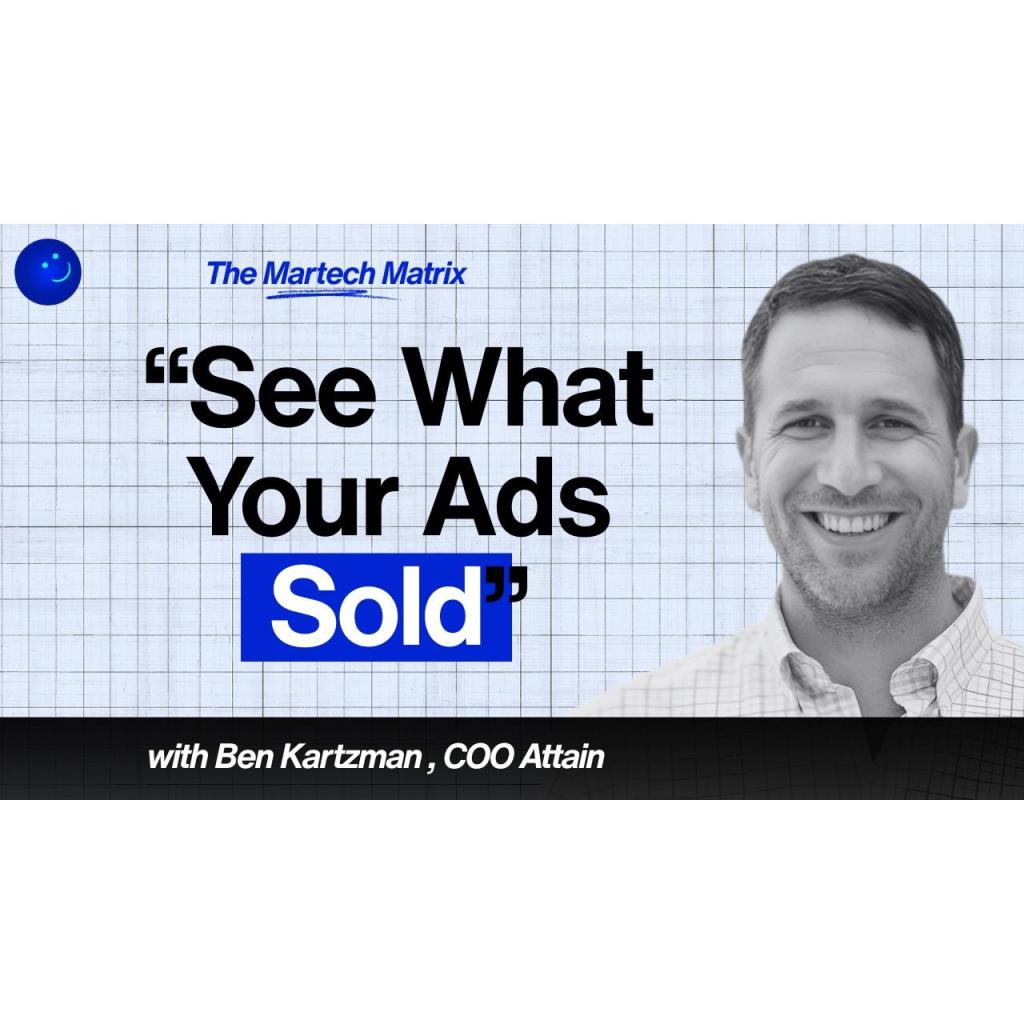

Marketers love to say they’re data-driven… but most of the time we’re chasing proxies (clicks, impressions, attention) instead of purchases.
In this episode, Sean Simon sits down with Ben Kartzman, President & COO of Attain, to unpack how brands can finally connect media exposure to real-world sales in (near) real time—then use that intel to optimize mid-flight, not just report after the fact.
We cover:
- Why proxy metrics took over—and how to replace them with sales outcomes
- How Attain’s permissioned, first-party purchase data from 10M+ consumers powers measurement without retailer blind spots
- What Amazon DSP’s first automated offline sales-lift partnership with Attain unlocks
- Real examples (Pilot Flying J, Sally Beauty) where optimization mid-campaign drove millions in incremental revenue
- The Insights product (who buys, what they spend, where they’re switching from/to) and how to build smarter audiences
- Where this goes next: predictive and agentic media
Listen and Subscribe from Your Favorite Podcast Platform

Takeaways
- Proxies → Outcomes: Clicks and impressions are easy to measure, but the outcome that matters is sales.
- Real-time purchase data: Attain connects publisher/DSP exposure to permissioned consumer purchases, enabling mid-flight optimization.
- No retailer blind spots: Because the data originates from consumers (not retailers), it avoids gaps like Amazon or Walmart.
- Optimization > reporting: When teams see live purchase lift, they shift from post-hoc “measurement” to in-flight changes.
- Audience Insights that matter: Identify likely buyers, basket size, competitive switching, and traits (e.g., Prime members, pet owners) to build precise segments.
- Proven impact: Brands like Pilot Flying J and Sally Beauty used Attain mid-flight to drive incremental sales.
- What’s next: A move toward predictive and eventually agentic media buying.
Chapters
- 02:37 Are marketers chasing the wrong things?
- 04:52 From proxies to sales outcomes
- 08:45 Why a consumer-permissioned data source matters
- 09:08 Real-time feed: minutes, not months
- 09:34 The value exchange: apps, points, 10M+ consumers
- 11:48 Scale & coverage across US purchase behavior
- 12:21 CTV example: Amazon Prime Live Sports → Taco Bell sales
- 13:53 Device independence & advertiser-set windows
- 14:34 Turning measurement into optimization (who/what’s working)
- 16:49 Methodology & scaling audiences
- 17:39 The industry’s sprint to real-time (vs. MMM lag)
- 18:49 Roadmap: predictive & agentic media
- 20:32 Where it runs: social, programmatic, audio, CTV (integrations)
- 22:43 Amazon DSP: first automated offline sales-lift partner
- 24:14 Case study: Pilot Flying J (mid-flight optimization → $$$)
- 25:25 Case study: Sally Beauty (new buyer sales lift)
- 26:59 Attain vs. MMM; convergence over time
- 28:31 Complement or replace? How brands adopt
- 30:06 Building segments with Insights; competitive switching
See What Your Ads SOLD: How Attain Turns Marketing Data Into Real Sales Insight
For years, marketers have claimed to be “data-driven.” But behind the dashboards, most of that data has been little more than proxies — clicks, impressions, attention metrics — designed to make reporting look impressive without actually proving what matters: Did the ads sell anything?
The Problem: Data That Doesn’t Tell the Whole Story
Modern marketing runs on metrics. But too often, those metrics are divorced from actual business impact. As Ben Kartzman explains, this is a legacy problem:
“In the early days, clickthrough was revolutionary because it was measurable. But it was still just a proxy. It didn’t answer the question every marketer needs to answer — did my product sell?”
Marketers have been measuring what was available, not what was accurate. Even in the retail media boom, attribution data from different partners often double-counts or inflates performance, making it hard to validate what truly drove sales.
The result? Fragmented reporting, duplicated outcomes, and a growing need for an independent, unbiased source of truth for marketing performance.
The Attain Approach: Permissioned, First-Party Purchase Data
Attain’s solution starts with an elegant foundation — data collected directly from consumers, not retailers. Through a suite of consumer-facing apps, users willingly share their purchase information in exchange for value, such as loyalty rewards, cash, or gift cards.
This approach gives Attain a first-party, permission-based dataset from over 10 million U.S. consumers — one of the most comprehensive and privacy-safe purchase data ecosystems in market.
“We’ve built a value exchange,” says Kartzman. “Consumers get rewarded for their everyday activity, and marketers get real purchase visibility without retailer blind spots.”
That last point is key. Because Attain’s data comes directly from consumers, it captures transactions across Amazon, Walmart, and other major retailers that often keep their data walled off from advertisers.
Real-Time Measurement That Powers Real-Time Optimization
Where most measurement tools stop at post-campaign analysis, Attain’s platform makes data actionable in real time.
When brands run ads through publishers like Amazon Prime Live Sports, The Trade Desk, or other DSPs, Attain can directly link those ad exposures to confirmed in-store or online purchases within minutes, not months.
That capability changes everything.
“It’s the ‘holy sh*t’ moment for brands,” Kartzman says. “They log into the dashboard and realize they can change a campaign mid-flight before the money’s gone.”
Brands like Pilot Flying J and Sally Beauty have used Attain’s data to identify which audiences are driving the most incremental revenue — then optimize toward those segments while the campaign is still live.
The result: millions of dollars in incremental sales, powered by actionable data instead of lagging reports.
From Measurement to Optimization — and Beyond
Attain’s innovation doesn’t stop at attribution. Its Insights product helps marketers go deeper by answering critical audience questions:
- Who are the most likely buyers of your product?
- How much do they spend — and how often?
- Which competitors are stealing your customers?
- What traits define your switchers (e.g., Prime members, pet owners, Netflix subscribers)?
These layers of behavioral, demographic, and psychographic data let marketers design hyper-targeted audiences and build more effective conquesting and loyalty strategies.
And Attain isn’t stopping there. The company is already exploring predictive and agentic capabilities, using historical patterns to forecast how future campaigns will perform.
“The next step is predictability,” says Kartzman. “We’re using data to not only measure outcomes, but to anticipate them.”
The Broader Shift: Marketers Moving from Proxies to Proof
The rise of solutions like Attain represents a broader shift across the MarTech landscape. As privacy regulations tighten and cookies crumble, marketers are realizing that true advantage comes from first-party data — and from partners who can transform that data into actionable intelligence.
Attain’s role as Amazon DSP’s first automated offline sales-lift partner underscores how seriously the industry now takes real-world outcome measurement. It’s no longer enough to know that people saw your ads. The future belongs to marketers who can prove that those ads sold.
Sean Simon (00:00.088)
So for example, we work with Amazon and Live Sports, right? Amazon Prime, Live Sports. And so when they run an ad for Taco Bell ad on Amazon Prime, Amazon doesn’t know if somebody went and bought that Taco Bell. We do. And not only do we know that, but when you think about incrementality, we can also tell you that this person was exposed to this ad, they have not bought Taco Bell within the last six months. I feel like marketers talk a big game about being data driven, right? But they’re often chasing proxies not on-
Do you see that in your space with your customers when they come to you or are they chasing the wrong thing? So in the early days, click through was really cool because it was measurable. It doesn’t answer the question that at the end of the day a marketer needs to answer, which is, you know, did my product sell? It’s the first time I’ve seen a company create a value exchange between consumers and their data. So we have found a way to pay users basically for access to their data.
Is that the holy shit moment for brands when they log into their dashboard and they see that data and they’re like, my God, look at this, we can make a change right now before the money’s gone. That’s exactly right. That’s exactly right. And now you’re starting to think about what can we do in the middle of the campaign? What can we do as this thing is actually running and cranking?
Welcome to the Martech Matrix, a blurbs production. Blurbs is a community platform built by brands designed around how they want to search for solutions, not how vendors want to sell them. It’s where marketers and e-commerce leaders find the right tech faster with clear answers and no sales fluff. Each week, we bring that mission to life interviewing Martech founders and industry pros to explain what they do, the problems they solve, and how the space is evolving all without the buzzwords.
And now your host, Sean Simon. Marketers love to say they’re data driven. But if you look close, most of that data is just dressed up in dashboards. We’re still measuring clicks and impressions while the real proof, the purchase, is sitting somewhere else entirely. Today we’re talking about how that gap is finally closing. My guest today knows that we’re all better than most. He spent his career helping brands bridge the gap between ad exposure and real outcomes.
Sean Simon (02:11.362)
Ben Cartman is the president and COO of Attain. And here’s their blurb. Attain equips marketers with real-time transaction data, empowering them to directly link campaign efforts to sales results with a focus on transparency and precise targeting. Marketers can tailor strategies based on real consumer behavior and actual purchase data, ultimately boosting campaign effectiveness. Before joining Attain, Ben spent years at MediaOcean where he saw firsthand
how fragmented media measurement had become. Now he’s helping build the bridge between marketing exposure and real world purchase behavior. Ben, welcome into the matrix. Amazing, thanks for having me. Excited to be here. Great, great. So let’s start with your story, Ben. You didn’t start at Tain, I know that, but you came in as president and COO about 18 months ago. What drew you to the company and what was the moment you realized that marketers were still optimizing for the wrong things?
Yeah, I mean, there are a couple things. So for me, you know, I had a great journey starting coming on sponge sells, selling his flash talking and then selling it again to MediOcean and having the opportunity to work at MediOcean and see the industry from that. That perch was was really eye opening. And one of the things that had spins kind of clear to me through the years is and has become even more prevalent in this AI first world that we live in is that data is king.
And so when I first met Brian and the team at Attain, one of the things that really struck me was the amount of first party data that Attain is sitting on, that it’s all permission, it all is based off and born out of a direct relationship with consumers that we have through a series of consumer apps that we own. And it just felt like to me that the problem that Attain was trying to solve
You could really only get there if you had access to data and if you had access to that data with the first party relationship to the consumer who was providing it to you. And so, you know, that was the opportunity and that’s what got me excited. I’ll talk a bit more about, you know, some of the specific things, but that’s really what kicked me off. That’s great. I mean, I love the perspective because you get from your different roles. gives you a different view of like how different people in the industry are dealing with this challenge. So I feel like marketers talk a big game about
Sean Simon (04:32.526)
being data driven, right? But they’re often chasing proxies, not outcomes. Do you see that in your space with your customers when they come to you? they chasing the wrong things? Yeah, I mean, think that’s what this industry on some level has been born out of. And I don’t know if it’s necessarily the wrong things as much as it’s the, these are the things that we have that are accessible to us. And so that’s what we’re going to go chase, right? So in the early days, like click through was really cool because it didn’t exist before. And so, it was, and it was measurable.
And so it was something to go chase. We quickly realized that that’s not a great metric. It’s just a proxy. It doesn’t actually answer the question that at the end of the day, a marketer needs to answer, which is, did my product sell? I ran a bunch of advertising and did it actually move product for me? I don’t want somebody coming into me and telling me like, which has been happening in the sort of retail media space over the last two, three, four years.
If you’re a marketer and you’re selling through a retail media chain and you’re running media through a retail media channel, if you add up the amount of product that every retail media partner tells you that you’re selling through them, it’s like three, four times what your company’s actually selling. And so I think there’s a challenge with both what we’re measuring, but then also how we’re measuring.
And I think that creates an opportunity for an independent partner who can validate the actual outcome, the actual purchase of a good, and to do it, to be able to do it at scale without any bias, and without any blind spots. And I think that’s, that’s kind of the thing that we’re marketers measuring the wrong things. I don’t know. I mean, I think it was just more measure marketers were measuring the things that were available to them. And now.
that we live in a world where we can bring purchase data to the forefront and we could use that to help marketers understand what parts of their media were working. Now I think we can start to do away with proxy metrics. We can start to leave them behind and really focus on true, everyone uses the word outcomes today, but really it’s about sales outcomes. It’s about, did I move more product because I invested media dollars to do that.
Sean Simon (06:55.726)
Yeah, it’s funny. mean, I brands talk about performance all the time. then when you dig in a little further, everyone’s got a different definition of what performance means to them. And at end of the day, should just be sales. I think this challenge is your point. Do they have access to data that connects the dots between the performance that they’re looking at and the sales? So when, when, when you first talk to a brand that comes to you or that you’re pitching, um,
Do you see brands fooling themselves? Like are they trying to convince themselves that they’re doing it the right way and that you can’t possibly teach me anything or like, what are the blind spots, right? That’s leading to those bad decisions. Yeah, think it’s marketers are trying to do the best with the resources that they have available to them, honestly. And I think it’s the solutions that they are bringing to the table for themselves, whether they’re homegrown or they’re, you
adopting solutions from third parties are born out of the resources that they’ve had in front of them for the time period they’ve been trying to solve this problem. So we come into the fold and we start to talk to them about this purchase data that we can bring to the table, how it’s unbiased, how it is all permission, how it’s born out of these direct relationships that we have with consumers, how there’s no blind spots in it. And we start to show them what it looks like.
big part of our demo is actually showing a live feed of the data. And when we get to showing that, marketers start to understand, they start to understand, wow, this is data that I didn’t have access to before. You guys now are bringing this to me. This is something that I think I’ve got to figure out how to work with. And so we don’t get too much pushback because there is a thirst for, you know, sales data. There’s a thirst for moving.
more towards, you know, outcomes that are again, like, did I drive sales? Did I move more product? and so it’s, it’s kind of hard to refute the data that we’re bringing and there’s been a gap in the market, right? There’s this, this type of data. mean, there have been companies out there that have been buying data from different, you know, retailers, and stitching it together. But over time.
Sean Simon (09:16.502)
What are those retailers doing? Those retailers like Walmart who used to sell their data, well Walmart now has a $4 billion media business. It’s unlikely they’re gonna keep selling that data. They’re gonna use it for themselves, because that’s like a scalar media business. And so I think will the long tail of retailers still be out there willing to sell data to companies who will stitch it together and try to paint a picture of what’s going on across the US and what US consumer behavior looks like? Of course they will.
But are they going to have massive blind spots? Yeah, they’re not going to have Amazon. They’re not going to have Walmart, right? They’re going to miss out on huge, huge swaths of purchase data. And when we walk into a marketer and explain to them, like, we don’t have those blind spots because our relationship comes from the consumer and the data we get is directly from the consumer, not from the retailers, I think their eyes open up because it’s a different pitch and it’s a different way to get the data. And so I think
Yeah, I think to me, I don’t think anyone’s fooling themselves. I really do believe that everyone is trying to do the best they can with the resources that they have in front of them. And this is just a new, it’s a new solution, right? It’s a new look at this type of data. Yeah, it sounds like the advertiser doesn’t need to make a deal with the devil anymore, right? I mean, they had to make a deal with Amazon or Walmart just because they wanted the data and they were like, okay, fine, I’ll give you my data.
But now they don’t have to, now they can work with you and get that data. When you see live data though, how live are we talking? Are we talking about like real time, hours, days, minutes? Like how live? Yeah, it’s a real time feed. I mean, we are seeing what consumers are purchasing. And then we are publishing that out and making decisions off of that within minutes. And it’s different. It’s a new paradigm for sure. That’s definitely a huge shift.
All right, so let’s dive into that a little bit more. Like walk me through how Attain actually connects ad exposures to purchases. Like where does the data come from? How do you make your privacy safe? Yeah. Yeah. So you kind of have to start with where we get the data from. And so let me actually walk through that quickly. And then I think that’ll help to explain how we can connect ad exposure to a confirmation of the purchase.
Sean Simon (11:40.824)
The thing that I think that we do and that I think we’ve solved better than anyone I’ve seen it before. And again, it’s another one of those reasons I talked about earlier that I was so excited to join this company is it’s the first time I’ve seen a company create a value exchange between consumers and their data. So we have found a way through these suite of consumer apps that we have to pay users basically for access to their data.
And so there are different things that they can do inside of our apps, whether it’s figuring out how to better balance their budget or it’s, you know, connecting loyalty accounts or it’s scanning receipts or, know, whatever, all the different things that they can do inside our apps to then earn points, which they can then redeem those points for cash or gift cards or whatever the case is. Like we’ve, we’ve figured out through these different apps that we own really how to
Help the consumer feel like they’re getting paid, you know, they don’t think about all getting paid for my data They think about I’m getting paid to just do the normal things that I do every day, right? And so yeah, I go shopping every day if I just remember I’m going to Taco Bell and I’m paying for campaign for you know my food with with cash and I snap a Picture of that receipt I scan it into you know frisbee, which is one of our apps I’m gonna earn points for that. So at the end of the day at the end of the week at the end of the month
I can aggregate all those points into cash for just doing what I kind of do every day. That’s a win for the consumer and it’s a win for us. And so when you start with the source of the data and how we get the data and the fact that the relationship is, it is permissioned by those consumers who share that with us, that then allows us to aggregate that up. And so now you take that across our suite of apps and you’re talking about 10 million consumers.
that we have that have used these apps that we have access to data from. That is a pretty large view of the US and what consumers are buying in any given day. So if you start there and that’s the place that you operate from, and then you move into actually connecting the data and the purchase data to ad exposure, we have a series of relationships and partnerships with all of the biggest
Sean Simon (14:03.242)
publishers and DSPs in the industry. think about Amazon, their DSP, the trade desk, right? These are the types of partners that we work with that brands will activate through. So for example, we work with Amazon and Live Sports, right? Amazon Prime, Live Sports. And so when they run an ad for a non-endemic advertiser, we’ll just make up an example. We’ll stick with Taco Bell there, right?
and they run the Taco Bell ad on Amazon Prime, Amazon doesn’t know if somebody went and bought a Taco Bell. We do. And not only do we know that, but when you think about incrementality, we can also tell you that this person was exposed to this ad. They have not bought Taco Bell within the last six months. But since seeing this ad within the last four weeks, they’ve bought Taco Bell. And so we marry the exposure data that we get.
from the publisher with the consumer purchase data that we get from our consumer panel. And when you put that together, we can start to report incrementality, attribution, all different types of other sort of ways to measure successive campaigns. So a couple of follow ups to that. Is it device dependent? In other words, do they have to see that Amazon ad on their phone and then scan the receipt on their phone and
Is there a time sensitive nature to that? In other words, do they have to scan that receipt within certain amount of time after making the purchase? Yeah, so it’s not device dependent, but it is time based. And that window can be set by the advertiser. So the advertiser can say, we want to see the incrementality window that runs up 90 days post the end of the campaign. Fine, we want to see what it looks like within 45 days, six months, whatever the case is.
So the advertiser can actually set that window so that they can basically define the parameters for what they want to see. And I guess the receipt oftentimes will have a timestamp on it too. So even if they do it a week later, you’re still getting the timestamp. So I get that how that helps with the measurement piece. Does it help with optimization or audience strategy as well? Exactly, exactly. It’s a great question. And it’s one of the big things that has
Sean Simon (16:25.25)
picked up a lot of steam for us is because when you walk in and you have this measurement conversation with a media buyer or planner, the measurement side of that conversation is often more detailed, more nuanced, takes a lot longer, but they’re actively working on something right now that they want to optimize. And so what can you give them right now in the moment that will help them be able to target the right audience who is responding well to
the particular creative or placements that they’ve got out in market. And so that is absolutely one of the things that you can do from our platform is we’ll tell you what is working and we’ll tell you, okay, it’s these placements and these creatives are working great against this type of audience. And the other cool thing that I haven’t really gotten into detail on yet, but not only do we know the purchase data, but we also know
demographic data that is associated with that consumer. And we also know a bunch of, psychographic data as well. And so when you can, when you think about that from an audience building perspective and from an audience targeting perspective, you can start to get pretty rich and also pretty granular, in terms of, know, what is working and who it’s working for the type of person that is responding to this. So it’s not necessarily about the, the one-to-one connection. It’s not about getting to that one person. It’s about.
identifying the type of person that is buying from you and being able to go out and find more of those people. And so that is a big part of our business is doing exactly what you said. Well, and sorry, you said something about one to one. And I was thinking about this when you mentioned 10 million people are opted in. Obviously, if Taco Bell runs a CTV ad through Amazon, everyone that sees it and goes and make a purchase isn’t in your network. Right. So
Is there like a mathematical formula that you give brands? Is it the same for every brand? To help them sort of project out like based on the conversions we saw and the number of impressions you received, this is how many sales you likely received from that ad? Yeah, that’s exactly right. Is it a unique formula for each advertiser? It’s not. It’s not. it’s more about the methodology on the measurement side and how we do it and then it’s applied broadly. Got it. Got it. Okay.
Sean Simon (18:48.14)
So on this show, we’ve had other vendors that focus more on the MMM and incrementality side of business. And, you know, those measurements tools have come a long way in terms of getting closer to real time. They’re not six months out, 12 months out like they used to be, but this is even more advanced. And maybe this plays into the ICP is maybe your ICP is different than their ICP. Who is this ideally made for? it?
the taco, like the quick serves, anyone that sells offline, like how do you focus your sales efforts when you think about ICP? That’s a great question. And it’s also a great observation, right? And so to your point, like the measurement industry is moving more as, everyone’s trying to get as close to real time as they can. And to your point, it used to be, got to wait six months, well, six months is too long, right? I can’t wait that long to optimize in this sort of programmatic world that we live in where everything is going.
more more programmatic and eventually we’ll be going agentic. so, you know, it’s not going to, that model just, it won’t work. Right. And so, so I think that’s that’s it’s a astute observation and I’m not surprised, you know, just to hear that, that is where kind of the industry is headaches. I think we, we have to head there. Otherwise, I think we’re going to become, I think we’re going to irrelevant basically.
So you mentioned the agentic. I was gonna save this question for later, but is that where you go next in terms of like today you’re able to create attribution in almost real time. Are you gonna get to the point where you’re actually predicting behavior based on historical campaigns and tell advertisers if you do this, then you’ll get this? So it’s like you’re sitting in our roadmap meetings.
I am not. For the audience, I have no idea. Yeah, there’s a lot of talk internally here around predictability. How can we use the data that we have to get more predictive? It’s a big thing that we think about, right? And I think a lot of that will have to come in partnership with the big buyers of media. And so whether that’s the big programmatic players, whether that’s the big publishers, right?
Sean Simon (21:06.274)
We don’t control media. We don’t sit on media. We just have this massive stack of data. And so when we think about that in the context that you are describing here, I think that’s a big part of the future for us, right? Is how can we actually get out ahead? Like, okay, we’ve seen this campaign before, or we’ve seen something like this where it’s tried to target this type of person and it’s run in…
with these specific parameters. And so I think you will see that, right? I think there’s probably opportunities for us to do that even on a product or skew level too. But that might take us in a whole different direction. But yeah, I mean, it all comes back to the data asset that we sit on, the uniqueness of it, and the more and more we leverage it and use it, then I think the smarter and smarter we will get with it. So…
Who does an advertiser need to work with? If they’re gonna work with a team, do they have to then work with, you know, an Amazon, the trade desk? Is there an ecosystem that they have to work within to leverage your services? Yeah, so there’s not, and it’s wide open. And I think this goes back to your question earlier on ICP. The nature of the data is such that it allows us to work with…
all different types of brands, right? So we talked about QSRs, CPGs are great for us. Insurance is great for us. Streaming is great for us. Think of anything that you buy with your credit card or your debit card. That’s the type of data that we have access to. Retail is obviously a huge channel for us. Those are huge partners for us. Delivery services are big for us. Travel is big for us, right? So…
When you think about it across that lens, what we felt like we had to do and what we had to solve as a company was, yeah, we want to walk into that room with any one of those, you know, buyers, planners, strategists, know, measurement analysts at any one of those companies and their associated agencies. And we wanted to tell them, yeah, you can run this anywhere you want. So if it’s in social, well,
Sean Simon (23:26.466)
We’ve plugged into basically every CAPI for every social platform that’s out there. So we’ve checked that box. It’s programmatic. We’ve got partnerships with all the big players that I mentioned. We’ve checked that box. We’re doing a bunch of stuff in audio now. And so every new channel that comes up, CTV is obviously a massive one for us. And so every new channel that comes up, we actually believe it’s on us to be the…
the sort of the integrators into the ecosystems that when we do walk into that room with, you know, said, you know, buyer, planner, brand manager, what have you, we’ve already answered the question that, you know, to your point, we know they’re gonna ask. I imagine retail media is like huge, right? Because that’s probably one of the hardest things to measure. So you mentioned a lot of different players, but is it true that Amazon was named Amazon’s, sorry, Attain was named Amazon’s DSP?
like first automated offline sales lift partner? I say that right? Correct. We were the first sales lift partner to be listed in Amazon DSP. That is correct. That’s a big deal. So what does that partnership make possible for advertisers that maybe they don’t realize if they’re listening today and they work with Amazon and they don’t know about this, like what does it unlock for them? Yeah. So what it does is it allows them when they’re running a campaign in the DSP and they want to track
and measure the success of that campaign to these real world outcomes that we’re talking about here, to these sales transactions, it allows them to do that. So just in the click of the button, we’ve done all the sort of plumbing behind the scenes. And this is the same thing. If you’re in the trade desk, you’ll see the same exact type of thing and type of setup in there as well. I like what you said about, you got my mind cranking around audio and CTV. Our last episode, which was with a company called Frequency,
They don’t get into the measurement space, but they work with a wide range of advertisers. And measurement’s always the challenge with audio, in my experience. This is something that I’ll definitely keep top of mind when I’m talking to brands about that. Can you bring this all to life? This is all fascinating because it’s very different than anything we’ve talked about on the show before. Can you give me an example or a story where a attained data changed the plan mid-flight, where a brand was using the
Sean Simon (25:51.15)
the solution and said, oh my God, look what we’re learning here. Look at these purchase signals or something’s unexpected. Can you talk through an example? Yeah, sure. mean, there’s a couple of good examples. So there’s one that we did with Pilot Flying J where they were looking to identify who were the consumers that were driving the most incremental revenue. And then they wanted to optimize to those consumers mid-flight.
So because we could actually see who was buying and what they were buying and the types of people that were buying mid-flight, we actually were able to then send over audiences that were closely correlated to the ones that were best performing, which Palachai was then able to put into action mid-campaign and go execute cans to drive a couple million dollars more of incremental sales. We did the same thing with
of brand Sally Beauty, same exact kind of thing, right? Like trying to help them understand mid campaign what was working and then drive, you know, new buyer sales lift, a percentage increase on that that they hadn’t seen before. So that’s the type of stuff that you’ll see and those are the types of customers that respond really well to it. Is that the holy shit moment for brands when they log into the dashboard and they see that data and they’re like, my God, look at this, we can make a change right now before the money’s gone.
That’s exactly right. That’s exactly right. And I’ll be honest with you, that was a big aha moment for us because advertisers, that’s what they were asking for. we were talking about, we were going in and we were talking about measurement. When you talk about measurement and you use the word measurement, you think about it in the way that you described earlier, right? You think about measurement. Okay, we’ll look at the data post campaign, right? And when we think of that word, that’s what that tells us. But if you use the word optimization,
Well, now you’re starting to think about what can we do in the middle of the campaign? What can we do as this thing is actually running and cranking? And so a bit of it was like, a bit of a mindset shift for us as well as for, for buyers. And then as you go in there and as we go in and we lead these conversations with optimization, that is how everyone thinks of us. And that is how everyone starts to use and wants to think about how to apply our data. And I think it’s been a, it’s just been a huge unlock.
Sean Simon (28:16.354)
for us and it’s made quite frankly the conversation easier with people because they can, to your point, can see it, they can feel it and it happens in real time and they look great, we look great, so everyone, everyone lives. Yeah, I it’s the blind spot, right? They can get click-based stuff, they can get their incrementality online. How does a team fit alongside those other types of measurements like incrementality or MMS?
Yeah, so we offer our own incrementality product. so, yeah, I mean, we’re out there in market, you know, trying to kind of show a new way to run incrementality. MMM, a little bit different. Like, we’ll think about partnering with those type of companies. But I think even in that case, like, we’re going to think about it more.
Again, in the optimization realm, then we’re going to think about it in the MMM realm today from where we sit. We’ll see how that evolves. imagine that will evolve. What’s going to happen? MMM, to your point earlier, went from 12 months to six months. It’s going to come down to three months. It’s going to come down all the way until eventually it’s going to hopefully live in optimization. I think these things will all converge. There are some out there that say they’re doing it daily.
So are you finding that you, you, changing the way a brand thinks about measurement, that’s a heavy lift, right? You need to like prove it to them. So are you finding that when you go into a brand, I think the focus here is really on brands that sell offline or omni-channel, where that blind spot is the offline piece, are you finding that they’re already working with an MMM or incrementality partner and they wanna use you for the offline piece? And then does it,
continuously live complimentary or does it eventually sort of take over and replace what they’re already doing? Yeah, I mean, what’s interesting about this space, which is probably not surprising to you is and to your listeners is it’s so varied, right? It is so varied. There are some that want to see it sit complimentary and they want to see our real-time purchase data get pushed into.
Sean Simon (30:36.654)
uh, MMMs, which, like I said, we’re, we’re, happy to do it because it makes us MMMs, uh, stronger. And then there are, there are others that kind of see the future and see that like the future is really rooted in the, in the data, uh, and where the data is coming from. And if, if we’re already sitting on this real time nature of data, uh, and we can optimize against it, then that is. What else do you kind of need after that? Right. I mean, like product is moving off the shelves and we can see that and we can tell that we can optimize to that. And that is ultimately the goal of.
you know, what any measurement solution is going to bring. So I think we’re going to do everything that we can to stay rooted in the in the real time nature of the offering, given the real time nature of the of the data and try to live as close to optimization as we can. Because I just it’s just it’s where it’s all it’s where it’s all headed. Do brands want to say like, let’s say it will keep using Taco Bell. Hey, you have 10 million people in your
your data set, we want to target ads to 5 million of them and not target ads to the other 5 million and measure the incrementality there. Is that a way that they leverage you and then you feed those audiences into the DSP or whatever? Yeah, I mean, that is one way we also partner with a few different identity spines so we can scale up those audiences and even scale down those audiences as they…
as they see fit. it’s probably less about like holding out 5 million of ours while testing against, you know, an existing 5 million of ours. It’s probably more about, you know, identifying the exact type of person. So it’s like, let’s say they want, let’s say they’re doing conquesting, right? And one of the cool things, we really talked about this, but one of the cool things that we offer is we launched this new insights product just a couple months ago.
And what the insights product does again given the nature of the data we can tell like you can go in and search on any brand that you want and or any retailer that you want or any qsr that you want and we’ll tell you Who the likely buyers are of your product will tell you average basket size will tell you how much these buyers spend on? This product over a given period of time will tell you how many are more likely to be male how many few about how many own pets how many don’t how many
Sean Simon (32:58.274)
Are they going to have an Amazon Prime membership? How many do not? But we’ll also tell you where these customers switched from and also where they’re switching to. So if you’re Taco Bell and you want to go in there and you want to target against who is the competitor that is stealing most of my customers? And I don’t know what it is I’ll talk about ahead, but let’s just say it’s Chick-fil-A.
You can go out and you can build a whole like a series of audiences it’s actually not just tick lab is tick fillet users who happen to have pets and also happen to have You know a Netflix subscription, right and they tend to live in the southeast or whatever So you can you now know who those people are? Because of our insights product is is providing you that and then you can go out and target against those people
And you can see and so like you could do the holdout strategies that you want to employ with the media that you’re buying and will supply you with the with the data to just to test it All right fascinating. So before we move on to the rapid-fire Segment of the show that I missed anything else. Is there anything else that people should know about attain that we didn’t cover? No, this was great. I think it was a pretty pretty comprehensive Overview, I think we talked about
A lot of what we do, where the data comes from, the privacy first nature of the data, the permission elements of it, how we work within the industry, the types of partners that we have. So, no, this is wonderful. Excellent. All right. So, rapid fire. Don’t overthink these. One marketing tool you can’t live without.
Sean Simon (34:44.898)
HubSpot. I’m saying it can’t be attained. Most overhyped metric in our industry. Attention. A brand you think is crushing data-driven marketing. Liquid death. First, finish this sentence. The future of marketing is. Agentic.
Excellent. Perfect. Ben, thanks for coming into the Matrix. This was awesome. If you want to learn more about Attain, check them out at attainoutcomes.com or start at trustblurbs.com slash attainoutcomes.com. And as always, thanks to our sponsor, Blurbs, for helping marketers find clarity in the chaos of MarTech. Take care. That’s it for today’s episode of the MarTech Matrix, a Blurbs production. To see what’s coming up next,
Visit themartechmatrix.com and if you’re looking for your next martech solution, start your search at trust blurbs.com where marketers discover vendors faster.

 Podcast
Leave a comment