
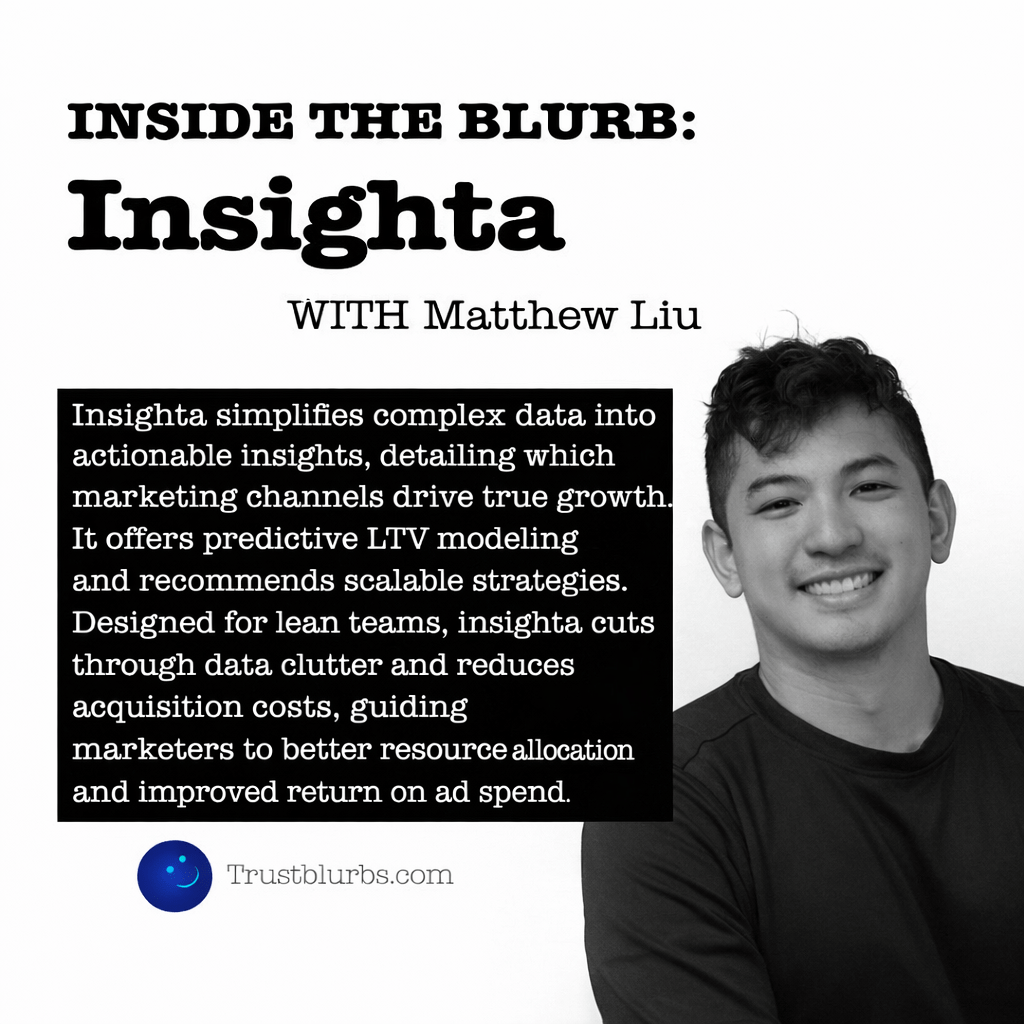

In this conversation, Sean Simon and Matthew Liu delve into the intricacies of customer intelligence and how brands can leverage behavioral data to make informed marketing decisions. They discuss the methodology behind Insighta, a platform designed to help marketers understand their data, optimize ad spend, and drive growth.
Matthew shares insights on the importance of predictive lifetime value, the challenges of multi-touch attribution, and the role of AI in marketing. The discussion also highlights the onboarding process for Insighta and the impact of data-driven strategies on brand success, illustrated through a case study with Obagi.
We cover:
- Under-Utilized Data
- Acquiring Customers vs. LTV
- Unified Measurement Techniques
- Predicting LTV
- 400 Day Look-Back Windows
- Data Interpretation.
- AI’s Role in Measurement
If you’re a marketer, eCom leader, or agency partner trying to keep up with changing measurement strategies, this episode is for you.
Listen and Subscribe from Your Favorite Podcast Platform

Takeaways
- Marketers have access to vast amounts of customer data, but much of it remains underutilized.
- Insighta focuses on understanding the cost of acquiring customers over time, rather than just immediate returns.
- The platform is particularly beneficial for brands in growth phases with significant ad spend across multiple channels.
- Insighta’s methodology combines various marketing measurement techniques into a unified approach.
- Actionability of data is crucial for marketers to make informed decisions.
- The predictive lifetime value feature helps brands identify long-term growth opportunities.
- Case studies, like that of Obagi, demonstrate the effectiveness of Insighta’s strategies in driving new customer acquisition.
- Understanding customer journeys can extend back hundreds of days, providing valuable insights into purchasing behavior.
- Brands should seek transparent partnerships in measurement to ensure accurate data interpretation.
- AI is increasingly integrated into marketing tools, but its application is still evolving.
Chapters
- 00:00 Introduction to Customer Intelligence
- 02:41 Understanding Insighta’s Methodology
- 05:34 When to Use Insighta
- 08:19 What Makes Insighta Remarkable
- 10:52 The Role of Data in Marketing Decisions
- 13:32 Navigating the Measurement Space
- 16:16 Onboarding and Support with Insighta
- 18:33 The Impact of Predictive LTV
- 21:12 Case Study: Obagi’s Success
- 24:00 Lifetime Value for New Brands
- 26:20 Client Engagement and Analytics
- 29:13 The Future of AI in Marketing
- 31:39 Pricing Models and Considerations
- 34:08 Final Thoughts on Measurement Strategies
Marketing Measurement Is Getting Harder—And That’s Actually a Good Thing
How Insighta reflects the shift from attribution theater to decision-ready truth
Marketers are sitting on more customer data than ever. But most of it never becomes insight, and even less turns into action.
That gap is widening because the measurement landscape is changing in ways that make “simple answers” harder to come by. Attribution windows are shrinking. Customer journeys are stretching. Channels are multiplying. And every platform still has an incentive to grade its own homework.
The result is familiar: dashboards that look precise but don’t match reality, teams optimizing to the wrong signals, and leadership asking the same uncomfortable question every quarter:
“Are we actually driving profitable growth—or just moving numbers around?”
This is the context Insighta was built for: not to add more reporting, but to help brands make cleaner decisions about what to scale, what to cut, and what to test next—grounded in reality, not platform math.
The biggest measurement flaw: we force cost and benefit into the same week
Traditional ROAS thinking is usually framed like this:
- “How much revenue did we generate last week?”
- “How much did we spend last week?”
- “Cool—there’s our ROAS.”
The problem is obvious when you say it out loud: spend and outcomes don’t happen on the same schedule.
Most ads don’t create purchases immediately—especially in considered categories, higher AOV products, or any full-funnel strategy. People see things, forget them, revisit later, click something else, get an email, talk to a spouse, come back… then buy.
So measuring cost and benefit inside the same narrow window often produces a clean number that’s fundamentally wrong.
Attribution windows are shrinking—and full-funnel marketers should be worried
Platforms are increasingly simplifying attribution views. When windows compress to one-day click and one-day view, it becomes very hard to evaluate:
- upper-funnel spend
- long consideration cycles
- cross-channel influence
- “assist” behavior that never gets clicked
When measurement is forced into a short window, signal gets replaced by distortion—and distorted measurement drives distorted decisions:
- cutting prospecting because it “doesn’t ROAS”
- over-funding retargeting because it “always ROASes”
- starving future demand to make current-week numbers look good
This is how brands accidentally optimize themselves into stagnation.
A better question: “What did today’s orders cost to create?”
Insighta’s core methodological shift is simple, but it changes everything.
Instead of asking:
“What did we spend this week and what did we get?”
It asks:
“Of the orders that landed today, what did it cost to get them?”
That’s activity-based costing applied to marketing: tie cost back to the order, not the calendar. The spend that created today’s order may have happened 13 days ago, 90 days ago, or 120 days ago.
This approach is especially important when you’re trying to understand profitability—not just revenue—because it’s much closer to how finance leaders think about cost allocation and unit economics.
And it avoids one of the messiest realities of platform reporting: duplicate credit. Facebook takes credit, Google takes credit, and when you add it all up it never matches the source of truth.
Insighta emphasizes getting revenue right by tying measurement back to the actual transaction system (Shopify, Magento, or a homegrown backend)—the “what’s in the bank” view—then mapping marketing cost to that truth.
What “actionable” measurement actually means
Most measurement tools stop at reporting. They show you numbers and expect you to figure out what they mean.
Insighta is built around a different promise: actionability.
If you can’t take a clear next step from what you’re seeing, the platform isn’t helping. It’s just producing prettier ambiguity.
This is where Insighta’s “decision matrix” concept is powerful: evaluate campaigns and ads at a forensic level to answer a practical question:
Is this specific ad driving incremental lifetime value?
If not, dial it back. Move spend. Try something else.
That is a different bar than “did it get a click” or “did it show up in last-touch attribution.” It’s decision-grade measurement.
The missing piece in most MTA: life beyond clicks
Multi-touch attribution often gets reduced to click paths—what was clicked, in what order, and what got credit.
But the modern journey is full of influence without clicks:
- view-through impressions
- CTV exposure
- YouTube ads that plant a seed
- display that creates familiarity
- offline touchpoints like direct mail
Insighta’s perspective is that anything that can be captured and should be captured belongs in the journey—including offline. For brands running direct mail, for example, the meaningful event isn’t “did they scan a QR code?” (almost nobody does). It’s whether a mailer landed, a customer later ordered, and that touchpoint can be stitched into the path.
This is what “full-funnel measurement” is supposed to mean.
Journeys are longer than your tools admit
One of the most eye-opening realities in modern measurement is how far back influence can go. Some customer journeys stretch hundreds of days before a first purchase.
If your tools can’t see past a limited window—or rely on fragile third-party cookie logic—you’re blind to the real path.
Insighta’s approach is grounded in first-party tracking and a customer graph designed to persist across visits, and then complemented with probabilistic methods when deterministic identification isn’t possible.
Importantly, it’s candid about the limits: MTA is not perfect. And that’s exactly why sophisticated brands don’t treat it as the only truth.
The new standard: the measurement “golden triangle”
The most useful way to think about measurement today isn’t “pick one method.” It’s build a system that triangulates reality.
Insighta frames it like a golden triangle:
- MTA (multi-touch attribution): granular, order-level paths and tactical optimization
- MMM (marketing mix modeling): a broader read when user-level tracking falls off
- Incrementality testing: the truth serum—what changes when you actually change inputs
If you can run these in tandem, you’re no longer arguing about whose dashboard is right. You’re building a decision engine.
Where AI fits (and where it doesn’t—yet)
AI is everywhere in marketing conversations, but measurement is a place where honesty matters.
In Insighta’s worldview:
- machine learning does the heavy lifting for prediction (including LTV modeling)
- AI is most useful today for automation (onboarding, tagging, operational workflows)
The important nuance: we’re not at the point where you can treat AI like a perfectly consistent oracle for measurement decisions. Ask the same question twice, get two nuanced answers. That’s not something you want controlling large budgets without human judgment.
Marketing is still art and science. AI helps most when it removes manual friction so teams can focus on the parts that require taste, context, and trade-offs.
Who measurement like this is for
A platform like Insighta isn’t for every business, and that’s a good thing.
It tends to make the most sense when:
- you’re spending meaningfully across multiple channels (not just one)
- you care about LTV, not just immediate ROAS
- you’re trying to scale responsibly (often with investor pressure)
- you need a clearer view of profitability and new customer growth
- you’re tired of channel-by-channel bias and duplicate credit
For smaller advertisers with limited channels—or businesses where LTV isn’t a critical lever—simpler tools may be “good enough.”
But for growth-stage brands trying to move from reactive reporting to predictive decision-making, the bar is different. The goal isn’t more data. It’s better decisions.
The takeaway: measurement is moving from “credit” to “causality”
The measurement era we’re leaving behind was about attribution and credit.
The era we’re entering is about truth:
- what actually caused growth
- what actually drove profitable customers
- what should we do next week that will still make sense next quarter
That’s why platforms like Insighta are resonating. Not because measurement got easier—but because the old shortcuts stopped working.
If your measurement stack can’t connect spend to real outcomes across time, channels, and customer value, you don’t have measurement. You have math that makes you feel better.
And the market is done paying for that.
And if you want to see how one vendor is tackling that problem head-on, you can explore Cohley’s full profile, claims, and case studies—plus even ask them anonymous questions—on Blurbs.
Full Transcript of the conversation with Matthew Liu
Sean Simon (00:01.356)
marketers are sitting on more customer data than ever. But most of it never turns into real insight or action. On Inside the Blur, we skip the decks and go straight to how technology actually works in practice. I’m Sean Simon, and today we’re diving into customer intelligence, behavioral data, and how brands turn signals into decisions with Matthew Liu, founder and president of Insighta. Matthew, welcome into the matrix.
Matthew Liu (00:26.955)
Thanks, Sean. Thanks for having me. Really excited to be here.
Sean Simon (00:29.58)
Yeah, likewise. So let’s read your blurb. Here’s how we describe Insighta on blurbs. Insighta helps marketers understand their data to drive growth. By combining precise multi-touch attribution and predictive lifetime value, it identifies profitable customer behaviors and optimal ad spend. This clarity lets marketers stop guessing and focus on strategies that actually work, adapting to rapid shifts with real-time performance insights.
Matthew Liu (00:58.647)
Yeah.
Sean Simon (00:58.966)
So you just heard the blurb. How do you expand on that in practice? Like what does insight actually look like day to day for teams using it?
Matthew Liu (01:06.135)
Yeah, I mean, I think to really talk about the value in Insighta it really goes down to the methodology. So every single marketer is trying to understand what their return on their ad spend is. That’s probably one of the most common measurements of how are my ads performing. But the way you get to that ad spend is critical. And if you think of traditional marketing measurement, the way they look at ROAS is they look at how much
Benefit was generated in a given period of time. So let’s say last week I generated a hundred thousand dollars in revenue How much did I spend last week? Typically is what they ask. Let’s say they spend fifty thousand. So they have a two dollar ROAS, right? The issue is if you think of When you spend advertising dollars today, you’re not necessarily buying an order today Like when you like, you know, ask yourself the last time you saw an ad Sean
did you make a purchase immediately after seeing it, right? And the answer typically is no, especially if the product is like a very highly considered purchase, like maybe a high $1,000 product, like you’re not gonna see an ad and then impulse buy that. But the way we measure benefit and cost, it’s in windows of time. I don’t know if you knew, but recently Facebook and Meta they just announced.
that they’re actually deprecating certain attribution views on the 12th. So they are removing their seven day click, 28 day view and only relying on a one day click, one day view attribution window, which is crazy because like you’re, it’s very difficult to, especially if it’s a, a, a, a whole funnel campaign to be able to evaluate, um, that, that cost and benefit in the same period of time.
So what Insighta really does is instead of saying, how much did I generate in revenue? What was my cost? It’s saying of the orders landed today, what did it cost me to get that? And that’s a very different question. That cost could have come from 90 days ago, 120 days ago, up to it could have been 13 days ago.
Matthew Liu (03:22.168)
But if you’re using it last click, one day view, one day click, you’re never going to get that correct signal to see how much you’re actually driving in profitability and revenue.
Sean Simon (03:32.59)
So you’re reverse, I don’t see reverse engineering, but you’re looking at it in the reverse compared to other solutions where they’re saying, okay, here’s what you spent. What did you get? You’re saying, what did you get? And how much did you spend on those people? And so you have to map that back, right? So you say, okay, Sean Simon converted today. How many times did we touch him? And what did those impressions cost me in order to get that conversion? Is that?
Matthew Liu (03:56.395)
Yeah, so it’s like for finance people out there, it’s like activity-based costing, right? You’re tying the cost to the actual order that was generated. Exactly.
Sean Simon (04:05.39)
Makes sense. And then on the on the Facebook thing, I hadn’t heard that. So doesn’t isn’t that a negative for Facebook themselves? Like won’t they get or won’t they be attributing less credit to themselves?
Matthew Liu (04:16.023)
Yeah, I think I’m curious on exactly why I didn’t look into the reason on why they’re doing that. I do know though from there are, you know, various windows of attribution. I think they’re just trying to simplify the process and just create one single source of attribution. Now the challenge there though,
Sean Simon (04:23.085)
Yeah.
Sean Simon (04:33.634)
Hmm. That’ll interesting.
Matthew Liu (04:36.951)
is with traditional measurement, there’s gonna be duplication in benefit. So Facebook’s taking credit for an order and Google’s taking credit for that same order. If you go into the separate platforms and try to sum up the revenue and you’re using a Shopify ecosystem, that revenue that you’re summing up across the different platform is never gonna match one-to-one with Shopify.
So inherently, have this methodology to try to track the revenue, but it’s hard to actually see what’s going on if you don’t have a single source of truth of revenue. And I think that’s what we do at Insider. Not only do we get the costing model correctly, but we’re tying it back to the source of truth revenue, whether it’s Shopify, Magento, Homegrown system. Yeah, exactly.
Sean Simon (05:27.118)
What’s in the bank, right? what’s in the bank. All right. So at what point in the company’s journey does Insida really make sense, right? Because if they’re only in one channel, it doesn’t make sense. So when do teams usually realize they need to spend or need to subscribe to something like Insida?
Matthew Liu (05:42.603)
Yeah, I would say if you are in a growth phase and you’re trying to optimize across multiple channels. if you’re in, you’re trying to scale in TikTok or YouTube or CTV, I would say if you’re generally spending larger budgets, like a million or more in ad spend across a diverse group of channels, I think that’s when you need to start looking at like an omnichannel approach.
Sean Simon (06:04.962)
So like a million dollar ad budget across multiple channels, at least two channels, obviously, right?
Matthew Liu (06:10.111)
Yeah, yeah, probably more too. I think, yeah. And then also a lot of people have this view, this notion that like, it’s offline channel, I want, can’t measure it.
in like a multi-touch view. So for instance, we partner with like Postpilot and Ellis Direct and all these other mailer companies. We can actually directly insert when Sean received a postcard in his mailbox and if that converted to an order. A lot of people try to use QR codes, which is like a very small percentage of actual people who scan that. And so we work directly with the advertiser to say, hey, when was that mailer sent?
and did they land in order and then stitch that in that customer journey.
Sean Simon (06:56.59)
Yeah, I I worked in the program actor, came out space at the very beginning of its existence and it was frustrating because brands would want to use either QR codes or vanity URLs. And it’s just isn’t how shoppers make. And so we never got the fair credit for it. This is going to be much more effective. So in terms of your client size, do you focus more on mid-market versus enterprise? Where’s your sweet spot when it comes to company size?
Matthew Liu (07:23.925)
Yeah, I would say it’s mid market. the kind of realization that the whole reason why I built inside it was I worked for a mid-size company, kind of smaller end. But when I first came in, I was the first kind of marketer. And we scaled from zero to 250 million in the course of four years.
I was managing their $30 million ad budget. but you know, I was looking at the different tools that were out there and it’s like, you could try to build this in house. but most DTC companies don’t have a tech team. They don’t have a CTO. don’t have, they don’t have the infrastructure and they don’t really need it to be honest. And then the second alternative is to try to buy. So now it’s a bill versus buy. So now you’re going to buy something. But again, all of the traditional pitfalls of, you know, is the attribution correct? Is the revenue summing correctly?
and then the LTV piece, which we haven’t even gotten into, like, are you actually being able to capture for every ad that you spend? What’s the incremental lifetime value of that? Like those weren’t being answered. And so basically out of necessity, I’m like, I know a lot of midsize companies need this type of solution, but it’s cost prohibitive. They don’t have the talent need to build in house. And, like the solutions out there aren’t, aren’t doing what they they’re needing.
Sean Simon (08:43.022)
Yeah, I think building is strictly for the largest companies in the world that have extra resources that can afford. Otherwise you’re taking your eye off the ball. You’re not focused on growing your own business and you’re not experts in measurement in this case. And, you know, you’re not equipped to sort of evolve the solution as technology changes where the market changes. Right. So on, on the blurbs page, we, talk about like, what makes you remarkable? What makes you special compared to.
say your competitors or the ecosystem. I’ll read your what makes you remarkable and then we’ll talk about it. So it says, insider brings, and by the way, this is written by Matthew. Insider brings clarity to one of the messiest areas of marketing. Measurement, instead of relying on siloed bias or slow tools, Insider unifies MMM, mixed medium modeling, MTA, multi-touch attribution, and product analytics and incrementality into a single truthful source of insight that shows what’s actually driving growth.
It moves brands from reactive reporting to predictive decision making, delivering fast, statistically sound guidance on what to scale, what to cut, and what to test next. So there’s a strong philosophy behind that, obviously. So what makes that your remarkable statement? What does it mean in practice, I should say, for customers in terms of how you built Insight?
Matthew Liu (10:01.591)
Yeah, I think I really liked the mantra like for marketers by marketers. So I’ve been in the hot seat, you know, as one trying to convince the CEO, Hey, we need to be spending, you know, X amount of money in this channel, or we need to be dialing back. So I think one of the biggest advantages is our team our you know, previous ad agency GMs are
operators in the space when it comes to performance marketing, we’ve managed data teams, we’ve dealt with the problems, we’ve had to deal with investors who are looking to say, you know, well, what is your company valued at? And you can’t do that with that lifetime value. So I think a lot of it comes from experience of having to struggle through the problem that most marketers face to be able to grow, grow the kind of grow the pie overall.
And, it goes beyond just having a dashboard with numbers on it. I think that action ability is a key component. If you don’t have action ability, then what’s the point. And one of the biggest things that we have is called the decision matrix, which allows you to evaluate, campaigns and ads on a very forensic level to say, is this specific ad driving incremental lifetime value? If not, let’s dial it back. Let’s spend in other channels and opportunities. So it’s a real tangible way for marketers.
to action on the data that they see.
Sean Simon (11:31.992)
Sometimes on this show we’ll talk about gut verse data, right? And you get that any kind of pushback from brands where they’re like, I see what you’re saying. Like I see the data, but my gut tells me something different just based on my experience. Do you get that at all?
Matthew Liu (11:35.115)
Yeah.
Matthew Liu (11:44.587)
Yeah, mean, yeah, we get that a lot. So for example, we integrate affiliate marketing as well. And the most common question we get asked is, you know, would they have purchased anyway? Right.
And that’s a common question, but what we see in the data is when you stitch all together affiliate marketing with social and mailers, we see a large percentage of those customers that are new or large percentage of affiliate customers come in as new customers. So for example, one of our clients, which we can talk about Obagi.
Like 50 % week over week, 50 % of the customers that are coming in through affiliate channels are net new customers that don’t touch any other channel. You know, so in this case, it’s like, well, their gut feeling is like, well, we can’t scale in this channel. Like there’s nothing to scale in. It’s extremely difficult to do. Um, and so in this case, it’s like, well, we can tell them that the data shows that it’s not hurting you, you know, so you should continue to spend where, where
it allows, but to your point, yeah, like you can’t really scale. So their gut feeling is like, can’t scale in this channel, right? There’s, not enough publishers. There’s not enough resources to go do that. So their gut feeling is kind of validating that, but what the data enforces, it gives them insights to say, well, it’s actually good. It’s not hurting you. It’s bringing more new customers from, you know, where you otherwise wouldn’t have.
Sean Simon (13:11.842)
Yeah, dig in further. So when you say that it brings in new customers that haven’t been impacted by or influenced by other channels, are you also tracking whether that user has actually been to the website already? Because I think that’s the biggest concern with affiliate is like, they’ve been to my site, they’re ready to check out. Now they’re going to go get an affiliate code and come back and get a discount. Are you able to track that as well?
Matthew Liu (13:35.455)
Yeah, yeah. So we track every single event that happens on the website. And initially it’s anonymized, right? Until that person identifies, we wouldn’t know that it’s Sean that came to that visit. But whether it’s cross-device, whether it’s cross-plot, whether they’re Safari or Chrome, we were able to stitch with high certainty individuals that are coming to the site but haven’t yet made a purchase. Something that’s really astounding is that we can
see customer journeys back 400 days before they even make a purchase. And this could be in a Google campaign or a Facebook campaign. So what’s eye opening is that, you know, some of these, these journeys are very long tail, but people just don’t have the capability to, to see that because of the technology that they’re using, or they’re just not familiar with the space.
Sean Simon (14:27.374)
400 days, is that like the life of a third-party cookie?
Matthew Liu (14:30.721)
So third party cookies actually get deprecated or reset depending on Safari. It’s like the same day. Google can be up to seven days. So we actually don’t rely on third party cookies to create the customer graph. We rely on first party cookies. So we actually implement a server side pixel, which issues a unique identifier for that individual any time they hit the website.
Sean Simon (14:38.296)
There you go.
Matthew Liu (15:00.695)
persists regardless if you erase your cookies or not. Think of it like a gym membership. We issue it to you and so we’ve identified that and that can’t be erased unless you go back in on the backside and just delete it.
Sean Simon (15:13.218)
And then every time they come back, it restarts to 400 days.
Matthew Liu (15:16.479)
Yeah, yeah, anytime they come back it re-identifies. So it could be even more as long as they continue to come to the website.
Sean Simon (15:23.854)
So it’s no secret, this is a really noisy space, right? We’ve had multiple companies on this show alone. So when buyers compare Insighta to alternatives, how do you help them understand where you truly fit and when they should choose you versus someone else?
Matthew Liu (15:43.711)
Yeah, that’s a good question. mean, there are a lot of great tools out there that exist that are more affordable and for that are more simplistic. I think Insida is good for those who were lifetime values, a really critical component of their business. If you are a company that is more of like a one and done or, like a high purchase, like cars or e-bikes, know, those things may, may not be as relevant because lifetime value isn’t a key component.
I think those tend to fall off if you, you know, your budgets are very limited. You’re only in one or two channels. You basically know it’s either organic or those two channels that are feeding your revenue, even though you may not have like deduplication or a sophisticated attribution model.
One other thing that I think does shine though is outside of commerce, like we have clients that are using it for Legion. So we have, work with banks and insurance companies, you know, and we’re talking with even schools for applications to see, you know, is this individual who saw this specific ad, which may have been like two semesters ago.
you know, are they coming back? whether the convert, if the converting event isn’t an order, if it’s a form fill or a survey, we really shine in that space as well. But it begins to fall off if you’re in Amazon even. like,
If we can’t apply a pixel on your website for MTA, then we can’t get that visibility. So Amazon, TikTok shop, those are harder from an MTA perspective, but that’s where we start relying on the MNM, right? But again, there’s pitfalls of those different types of methodologies. And just to recap, if you’re an Amazon or TikTok shop, meta shop, or smaller budgets don’t need something super sophisticated, you probably aren’t a good fit for us.
Sean Simon (17:27.598)
you
Sean Simon (17:44.163)
Yeah, it’s a challenge, right? Cause there’s a lot of players out there. mean, given that you were, you know, you were brand side, right? How do you, how do you help, let’s say you’re talking to a friend who’s on brand side, like how do you help them figure out how to navigate the space? Right? I’m not asking you to like, you know, obviously you want brands to use you over, over the competitors, but at the same time, you don’t want to, you don’t want to be the wrong fit. Right? So how do you, how would you instruct somebody that
that sits on the brand side to think about the types of measurement partners they work
Matthew Liu (18:16.791)
Yeah, I think one probably the key thing that I encourage people to do is just to get educated Look for a partner. That’s transparent We you know, I think closed models black box models There’s a reason why they’re hiding it from you There’s a reason why Facebook doesn’t give you the view through data Right, or they don’t give you that customer is because they know for some way or reason that
Sean Simon (18:34.379)
you
Matthew Liu (18:45.68)
not to say that they’re hiding anything, but I think the best type of partnerships are ones that are open and transparent.
First and foremost, find a partner that you’re comfortable with and transparent with and that you believe in the methodology. Now, some people, I worked at a place that they didn’t really believe in MTA. That’s just not my wheelhouse and that’s totally fine. There’s no perfect marketing solution. If there was, then we wouldn’t be having this conversation, but find something that works best for you that you believe in and you can have a transparent, open relationship with.
Sean Simon (19:20.294)
how you value the numbers. There are some solutions that have been on the show that seem to me to be more customized. In other words, some are more out of the box. Like here’s our product, we’re going to put up our pixel and we’re going to measure and we’re going to do our thing. Then there’s others that actually are tweaking it to be customized for their specific business, vertical, size, whatever it might be. What is your approach? Is it more custom or does it lean more out of the box?
Matthew Liu (19:49.397)
Yeah, I think like any great solution probably needs to have a combination of both. Even like the thinking or the thought process of how we do measurement is completely different than what people are used to. And so I do believe that there is an education piece that you need to be able to use the platform to its fullest.
So we do have a guided solution for those that are, you know, looking for a solution, but don’t maybe have the.
the know how or the analytic analytical like horsepower to be able to make those driven decisions. So we offer that to people who, who want more of a involved kind of relationship. but we also offer, you know, if they just want to use the platform and make their own decisions, they work with their average, their agent marketing agencies as well. And kind of have the symbolic relationship as well as, I think it’s important to have.
like resources available. So we provide a way for individuals to have like, we have like active Slack channel where we connect with them. They can ask questions on the daily. You know, and so I think that education piece is really important because if you don’t have that, then they don’t know how to use the platform and so forth. So I think it’s a fine balance, but I think both are important.
Sean Simon (21:13.228)
Yeah. Yeah. All marketers need to be really savvy on the numbers these days. I’m glad you mentioned LTV a few times. And one of the claims that you make on bloggers on your website and also on blurbs is that your predictive LTV feature helps brands invest in channels driving long-term growth. So can you give us an example of where this kind of changed a real decision that a brand was making?
Matthew Liu (21:18.549)
Yeah.
Matthew Liu (21:39.253)
Yeah. so we had a brand that they were before they engaged with us, they were down new customers, about 10 % month over month, year over year. So they were struggling to try to generate new customers. And then also the retention was down. So what we were able to help them do is identify, you know, which, which campaigns are.
are not
are not driving future growth. if we look, the first thing we did was we evaluated how their budget was being spent. And it was like 80 20, meaning like 80 % of their spend was in like lower funnel channels. And right there in my mind, that’s a pretty red flag, pretty big red flag. If your spend, if your most of your spend is in lower funnel, what you’re doing is you’re just hitting the same people in over over and you’re just cannibalizing your own.
your own business because you’re not reaching a further audience to then drive down to the lower part. So we’ve identified, you know, hey, which campaigns are you running? Are they efficient from a lifetime value perspective? And what we found is that most of those campaigns, they were driving a high AOV actually. But when it came to were you retaining those customers, they were falling off. They were not coming back and purchasing.
And the way we combated that was because we have this forensic view of attribution where it’s on the order level, we know everything, every single touch point that led to it. We can pivot that on the product level. And so now we know on the skew level, which marketing campaigns are driving CAC.
Matthew Liu (23:31.211)
AOV and even LTV to CAC ratios. So what we did simply was we pivoted that data on product. And then we just, like in an Excel sheet, you just sort by the lowest CAC product. And those aren’t necessarily like your hero products. These are like products that are driving new customer growth. And we took the top nine products and we put it on a hidden landing page. No.
obagi.com slash new customer offer.
And you can only access that through a social media paid link. And they did a campaign, they spent X amount of dollars specifically to drive traffic to that site. So when we talk about action ability, right? Like how do you get a platform that’s actually like clear in helping marketers be successful? Well, we’ve identified products that are low, low hanging fruit from a new customer perspective. They have campaigns.
working with the ad agency to create some type of prospective new customer strategy.
And then working with the brand, created that landing page where you could see the direct impact of is this specific campaign driving new customer growth? And what we saw is that over the course of three months, they received record breaking new customer growth year over year. So in July of last year was their highest in customer growth up until that point, which
Matthew Liu (25:09.769)
was on par with November of the previous year. So basically Christmas in July is what we coined it because their new customers are almost as high as the prior year November. And it was driven specifically from this campaign and we could see it. Like we can look at all the orders in Shopify and we can see which campaigns they touched. And the majority of the new customers that were coming in were coming from this specific campaign. So it was remarkable to see.
Sean Simon (25:34.99)
That’s brilliant. So tell us more about Abhaji. You have a case study on the blurbs page. And so what is it, first of all? I never heard of the brand. And talk to us about the problem they came to you with and how you helped them solve it.
Matthew Liu (25:46.443)
Yeah. So yeah, we kind of maybe jumped the gun a little bit, but Obagi, they are a cosmaceutical company. So their health and wellness, they are based in California. They are, owned by, a private equity company. And so again, like you’re talking like midsize company, they’re spending, you know, eight figures of marketing annually. they have nine figures in revenue. And so this is not like you’re.
mom and pop shop that’s trying to have like trying to scale. But again, they’re, they’re facing growth issues at their stage, right? So they came with us because they were, you know, they realized their new customer and retention growth year, year over year was failing. And we came in there, we looked at their products. We looked at, you know, the health of their campaigns from an LTV perspective. And when we were able to do that,
It was funny because their investors had set goals for Q4 of last year. And the goals that they had set were like, oh, we need to hit X amount of new customers for December. And we exceeded that by 25%. And for them, that was a stretch goal. They’re like, think we, you know, this is a stretch goal. We should hit this benchmark. And we were able to exceed that. So I think, especially if you’re
company is backed or if you have VCs or investors, it’s all the more important to have lifetime value, a really sophisticated attribution model to be able to identify problems and opportunities and scale your company.
Sean Simon (27:29.816)
So I’m curious about lifetime value, because I understand the metric. I know what it’s about. How do you think about lifetime value with a brand that is fairly new, right? And maybe it’s a product that you don’t even buy maybe once or twice a year, right? So how do you know what the lifetime value is early on? so, know, I get it. If you’re established, you can do some backtrack of the math and kind of figure it out. But how do you do it sort of forecasting?
Matthew Liu (27:34.027)
Yeah.
Matthew Liu (27:58.175)
Yeah, so I think that’s one of the limitations of lifetime value and why midsize enterprises or midsize market is probably better because you’ve been around for longer.
But there’s really two types of lifetime value models. There’s historical or heuristic, which is, you take your past year, you look at how many of them came back from the prior year. So that’s your multiplier. Let’s say 20 % of them came back. So you can assume this year, 20 % of them will come back and you multiply that. So that’s more of like a very, you know, kind of a simplistic way of thinking of lifetime value. And the second way is a
It’s a Bayesian statistic way of thinking of lifetime value. So it’s a machine learning model that trains on historic data to then make a prediction, accurate prediction of, if Matthew came in today as a new customer, what will he be worth in one year from today? And being able to answer that question requires…
it requires more data and more technicality, right? And so I think with the limitations of, if you are like advice for younger companies that don’t have a lot of data.
use a historical lifetime value model to start. But once you start getting more sophisticated, once you get more data, more SKUs, you’re selling in multiple channels, you’re applying discounts and getting really, really, you’re trying to dial in an optimization, that’s when you should start looking into more of a machine learning predictive lifetime value model. Yeah.
Sean Simon (29:38.478)
Just treat them well so they come back. That’s really what it comes down to, right? Don’t worry about the numbers. It’ll work itself out. So who at the client or the agency owns Incyto? Who do you work with mostly inside the organizations?
Matthew Liu (29:51.679)
Yeah, I work closely with typically it’s the the marketing agencies who are running the ads, trying to understand, like doing the keyword bidding or creating the ad set itself. So just trying to understand, you know, which one of these campaigns perform well. And then we work closely with the C suite. So directly with head of marketing, head of ecom.
They’re in the app daily trying to figure out where the best low-hanging fruit is.
Sean Simon (30:21.272)
So it’s obviously the agency size more media, brand size more marketing. Do you have situations where you’re working with a brand that has or an agency that has an analytics team that you have to work with?
Matthew Liu (30:33.879)
Um, so we, um, try to think. Yeah, at the moment, no. Um, we have partnerships with, um, both agencies, well, with agencies from that have, uh, that have clients that are more sophisticated.
that like, let’s say like one of them, they don’t have the LTP piece, but they have a really good reporting system. So we’ll maybe assist in some ad hoc analysis for them. But typically the clients that we have are, don’t have like a performance marketing engine and they’re looking for one.
Sean Simon (31:23.294)
That sense. So what does onboarding look like? How difficult is that?
Matthew Liu (31:27.883)
Yeah, onboarding depends on the platform, the transaction system that they’re using. Shopify is pretty seamless in terms of integration. We can do that within about two weeks. If they’re like a homegrown website, there’s a little bit more heavy lifting and also depending on the channels that they’re advertising in. typically onboarding is between two and four weeks. And to get actual insights is about…
an additional 30 days after we have onboarded because the nature of implementing a pistol, getting the data to feed and train the LTV models and other things, it usually takes about a month before we can get real insights in it. Yeah.
Sean Simon (32:11.354)
What’s involved? Sorry, was involved? Like who on the brand side or client, guess it’s more on the brand side is responsible. Like what do they have to do to get on board?
Matthew Liu (32:20.607)
Yeah, so first thing is they’ll get access to the app. When they go into the app, they’ll get a login. It’ll be basically empty. There’ll be a platform integration page where they can self-serve and just integrate which channels they’re in and which transaction systems they’re in. So that typically takes less than an hour, depending. And then so getting all the integrations through API for the automated data feeds.
and then setting up the UTM, so making sure all of their existing campaigns and ads have UTMs that we can track back to the customer journey. And then the last thing is getting that pixel placed on the website to track. Again, we don’t rely on third party cookies. They’re not as reliable. So usually they have like a dev team to implement a pixel.
Sean Simon (33:11.362)
What does support look like post-launch, like ongoing? Is it just a training or always there?
Matthew Liu (33:17.355)
Yeah, so we have the training is usually like a month and that comes free with, you know, just we don’t have any onboarding fees or anything. So typically we work with them pretty heavily with the first month. And then we have.
on demand like Slack channels where they can message us. We have resources on our website that they can look to. And so I think, you know, just having some type of immediate connection with Slack or email is typically how we continue to nurture that. And then if they have the guided solution, we’ll meet with them weekly or bi-weekly to go over, you know, strategy, higher level things and how their company’s been performing overall.
Sean Simon (33:47.629)
enough.
Sean Simon (33:59.439)
I’m going to assume it since it’s early 2026, I’m going to assume AI is still going to be a meaningful conversation, although a very vague one for a lot of companies this year. Where does AI fit into Insight?
Matthew Liu (34:13.141)
Yeah, I think AI, like we use pretty deep machine learning models to help with the predictions. So the heavy lifting is done on machine learning.
AI though, we use it a lot with automation. You’ve heard like a lot of companies can 10X their production by the use of AI. In terms of how we use that to help our brands, a lot of the onboarding processes can be automated. A lot of the tagging and…
but kind of the operational things can be worked on. I think a lot of people think that AI is like, you know, it’s this Pandora’s box where I can ask you questions and it’ll give me answers. I don’t think we’re quite there yet in terms of using AI to help you make consistent answers. You can ask it one thing, you ask it again, it’ll give you nuanced answers. So I don’t think from an AI perspective, we’re quite there yet, but from an operational, like doing the manual task,
Sean Simon (35:14.797)
Yeah.
Matthew Liu (35:21.945)
it’s really good at that. And it helps the brands use the app more seamlessly. It helps us be able to, you know, deploy features quickly. But again, marketing is just as much as an art as it is a science. And so until we get there, I’ve yet to see it really shine. Even in like, like automatic bidding, right? Like people are trying to create these tools to create the
ad set or create the creative or the images, like I have yet to see it really shine in that side of kind of creative side as well.
Sean Simon (36:02.342)
I think it’s generationally too, I think it’s going to take people some time to trust it enough to allow it to spend money, right? It’s one thing to take a recommendation for a restaurant or a recipe. It’s another thing to say, here’s a million dollars, it, you know, spend it. That’s scary proposition today that’ll take some time. How should brands think about pricing, right? Like I’m not asking for like your pricing, but like, do you think about it in terms of the model? What are you based on?
Matthew Liu (36:27.829)
Yeah, so what I’ve seen in the space, and this is pretty consistent, whether you’re looking at other competitors or not, or even in the measurement space, it’s typically like some percentage of ad spend or GMV. And the reason why is because there is a real cost when it comes to data movement. larger brands will have more data to move. And so they need to be able to scale that somehow.
And the way it usually goes is here’s three tiered buckets, right? If you’re in this spend or this GMV, then you’re gonna be spending this. So you can expect as your company grows that the marketing platforms will…
kind of they’ll grow with you, right? And if you are an expense control, and I think this is where we decided to use like ad spend instead of GMV, because if you’re an expense control and you cut back your spend, like we’re gonna incur that risk with you as well, right? We don’t wanna be overcharging on services that we’re not providing.
Sean Simon (37:32.536)
So we cover a lot, a lot of great insights here. Is there anything else that we should know about in Insighta that we didn’t cover here?
Matthew Liu (37:41.263)
yeah, I think when it comes to MTA, which, you know, is our bread and butter, like I would just really emphasize on, are you getting the source of revenue? Correct? Is it one to one? Are you doing the attribution? But where most traditional MTA falls off, it’s only the click based journey, right? But in reality, there are more things that are in that journey that
you can’t capture with a click-based view, right? For instance, like if an order was placed today, you know, there may have been eight clicks to land that order, but they could have viewed an ad or seen something without interacting with it. Like there could have been 22 different interactions that weren’t click-based, right?
And so I think that’s where Insider really shines is that we’re not only just getting that click-based journey, but we work with the advertisers to give you the view through. So even if you saw a YouTube ad and didn’t convert, we know that the advertisers serve you an ad and we can attribute that back to an order. being able to get that whole view of, I just encourage people to think more critically about MTA and not just the clicks, like,
view through, CTV, know, programmatic has a lot of display ads, and then offline mailers, like any touch point that or interaction that should and can be captured should be included in the MTA. So.
Sean Simon (39:10.606)
I think a lot of the pushback around MTA has been multiple devices, multiple browsers, right? On my phone, I got on a computer, I’m a different browser. And so you can’t make those connections from a click perspective. How do you handle that? Do you handle it the same way?
Matthew Liu (39:27.159)
Yeah, so it’s the deterministic piece. If they don’t identify it, then it’s hard to, I mean, you simply can’t, right? And that’s where it falls off. MTA is not a perfect solution, but there are ways around that. So there’s probabilistic stitching. So based on your journey and your click behavior, you can assign, you know, these sessions with high probability of belonging to Matt, even though he’s hasn’t self-identified. So a lot of people are now looking outside of deterministic stitching, which is basically, you know, Matt has accepted the cookie. Matthew has, um,
entered his email and we can use that to identify him. Now if he doesn’t accept the cookies and we can’t identify him then we don’t know if that’s who that is right so that’s the pitfall of first party tracking but using probabilistic stitching is a way around it and then looking outside of MTA that’s where you really need to rely on like an MMM or increment incrementality testing. I would call it like there’s like a triangle the like the golden triangle
Sean Simon (40:06.734)
you can.
Matthew Liu (40:27.225)
If you’re a company that’s really sophisticated, really want to grow, if you could use MTA, MMM, and incrementality testing in tandem, then you can get a really good read on how to scale the business.
Sean Simon (40:41.292)
Yeah, incrementality isn’t something we didn’t really talk about today, but that is something you do. Yeah.
Matthew Liu (40:44.735)
Yeah, that’s another thing as well, but definitely for another time.
Sean Simon (40:50.03)
Yeah, for sure. But it’s important. think I 100 % agree that being able to take everything at your disposal, and in this case, MMM, MTA, and incrementality, and that’s where the art comes in, right? Understanding the data and then applying it a certain way and testing it, right? That’s the whole game. If another source comes up in the future, don’t throw out the data. Matthew, thanks for taking us inside.
the Insight of Blurb. You can explore Insight as full profile, including the first 20 questions you should be asking. And you can ask questions anonymously, all at trustblurbs.com slash insighta.io. That’s I-N-S-I-G-H-T-A.I-O. I’m Sean Simon, signing off.
Matthew Liu (41:34.497)
Thank you.d by experts powered by Vinny, our AI agent who actually understands your tech stack and your needs. I’m Sean Simon and this was Inside the Blurb. See you next time.

 Podcast
Leave a comment