Table of Contents
Most DTC brands aren’t losing customers because they stopped caring. They’re losing them because they started taking them for granted.
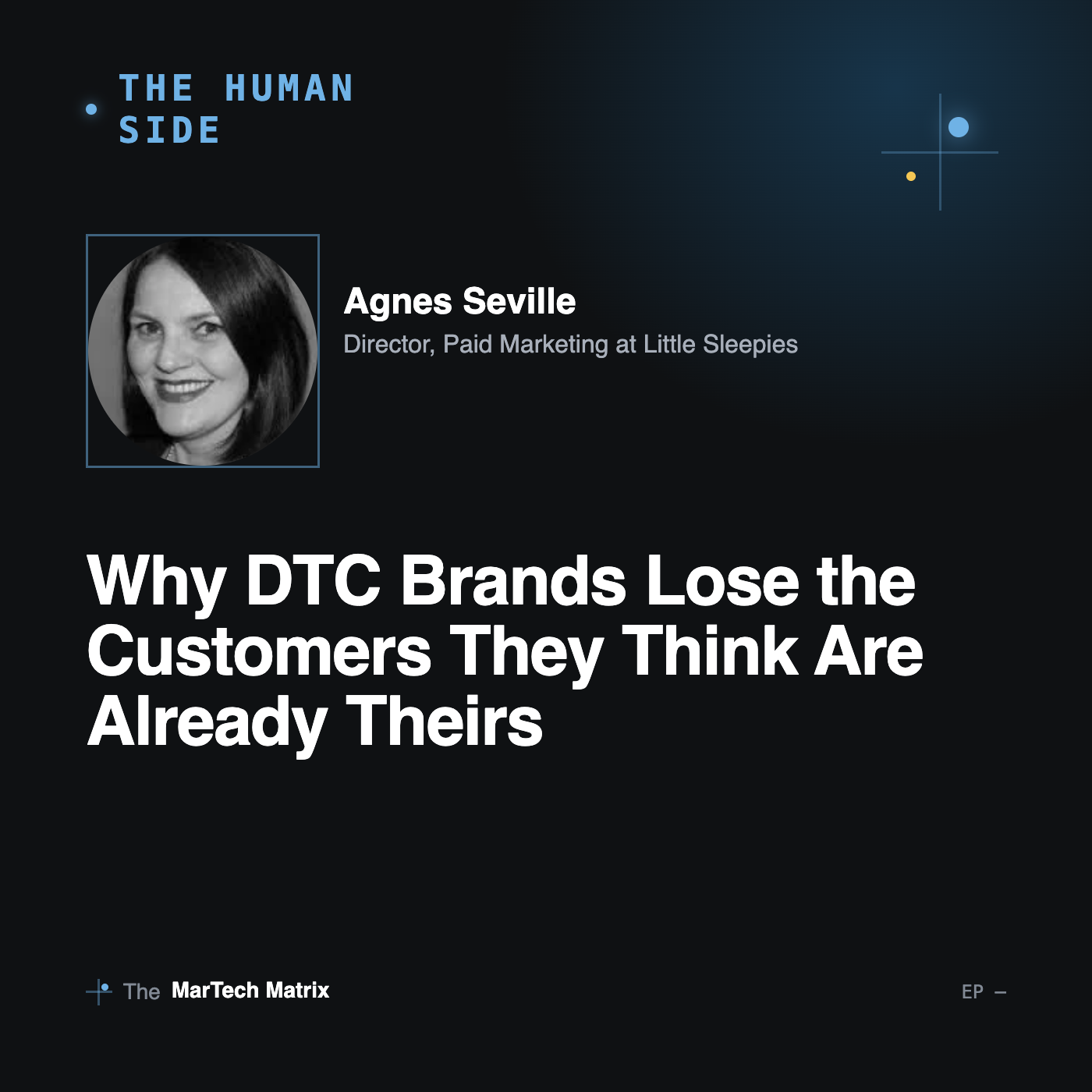
Agnes Seville has spent more than three years as Head of Paid Media at Little Sleepies — a fast-growing DTC children’s pajama brand with a 500,000-member Facebook community. Her take on what separates brands that grow from brands that plateau has nothing to do with the latest ad platform feature. It comes down to one fundamental mistake: assuming a past purchase equals future loyalty.
In this episode of The Human Side of MarTech, Agnes breaks down what real customer retention looks like, why brand and performance marketing fail when siloed, how Meta’s algorithm is reshaping creative strategy, and what DTC brands should actually measure to know if they’re winning.
Why It Matters
The DTC landscape has matured. Consumers have more options, faster shipping, and less patience for brands that treat them like a line item on a ROAS report.
The brands winning today have cracked something deceptively simple: they treat every customer interaction as if it’s the only one they’ll ever get. That mindset shift — from retention assumption to retention intention — changes everything from ad creative to customer service to community building.
What Makes DTC Customer Retention So Hard
DTC brands operate in a market where loyalty is no longer assumed. A customer who bought from you last month is one Amazon search away from switching.
Agnes frames the problem plainly: “Our customers today have more options than ever — in terms of products, services, everything available to them. You have the internet, which can bring you anything from anywhere in two days.”
For brands selling in categories with a built-in buying window — like baby products — the challenge compounds. Little Sleepies serves new and expecting moms. Babies grow fast. That means the brand must constantly acquire new customers while nurturing existing ones before they age out of the category. This creates a specific measurement problem that most brands get wrong.
How to Build Real Community (Not Just Say the Word)
The DTC space uses “community” loosely. Most brands mean a loyalty program, a hashtag, or an Instagram following.
Little Sleepies has built something different: a private Facebook VIP group with more than 500,000 members where parents share milestones, seek advice, and support each other through hard moments. The brand didn’t manufacture that dynamic — it created the conditions for it.
“The community is like a support group in a way,” Agnes explained. “All these moms and dads come together and they know it’s a safe place where they could share things that are maybe hard in their life.”
A community that exists to serve the customer will generate far more retention value than one that exists to serve the brand’s marketing goals.
The One Question Every DTC Brand Should Ask Itself
Agnes offers a reframe that cuts through most retention strategy debates: What if you knew this customer would never come back? Would you treat them differently?
“Don’t assume they’re going to come back. If you have that interaction with the customer, treat it as if it was your new customer.”
Most retention problems aren’t strategy problems. They’re attitude problems. Brands over-index on re-engagement tactics — daily texts, discount codes, retargeting — because they’re afraid of losing attention. What they actually lose is trust.
Why Brand and Performance Marketing Fail When Siloed
When Agnes is asked to choose between brand and performance, she picks performance. But her reasoning is more nuanced than the answer suggests.
She isn’t dismissing brand investment. She’s pointing to a structural failure that happens when the two functions compete instead of collaborate. Brand sets the identity and guardrails. Performance runs within that framework — efficiently acquiring new customers and nurturing existing ones.
“When the two teams work in a silo, then each one of them misses a part of that connection. And the results just won’t be nearly as good.”
The competition for attribution credit — “did this sale come from brand or performance?” — is a symptom of the silo, not a useful question.
How Meta’s Algorithm Is Forcing a Creative Rethink
Meta is no longer rewarding repetition. If a call-to-action mirrors a previous creative, the platform may deprioritize the ad. If the hook doesn’t capture attention in the first two seconds, the algorithm assigns it less weight.
Agnes has adapted by building internal systems to keep creative diversified and refreshed — across formats (static, GIF, video), hooks, and influencer scripts.
“The ecosystem has definitely evolved. It’s become a lot more needy. We need to feed the beast a little bit more.”
The implication is operational, not just creative. You need a pipeline for creative refreshes, not just a policy. If you’re running influencer content, different creators delivering the same script won’t fool the algorithm — Meta will recognize the message as a duplicate.
The Real Metric That Tells You if Paid Media Is Working
Revenue looks good on dashboards. It doesn’t tell you if your business is healthy.
Agnes keeps her team anchored to new customer acquisition cost (nCAC). For a brand like Little Sleepies — where customers naturally age out as their kids grow — nCAC is the metric that will make or break the business long-term.
“If it costs us three times as much to acquire a new customer than the AOV of their initial period, then we’re spending more money than we’re bringing in.”
She uses Northbeam for multi-touch attribution, cross-referencing with native platform data for day-to-day management. The anchor, however, has to be a profitability metric — not a platform metric.
“Revenue is a little bit of a vanity metric. It works when all the other pieces are in place, but I don’t think revenue should be your north star.”
How to Evaluate Marketing Technology Without Wasting Time
The DTC marketing stack has never been more crowded. Agnes’s evaluation framework is deliberately simple: Does this tool solve a specific problem I actually have?
But she goes further than most — she accounts for the full cost of a new tool, not just the subscription price. For a lean DTC team, the human capital required to onboard, learn, and manage a new platform is often the deciding factor.
“We want things that help us do more with the same amount of time. If that cost equation shifts to where I’m going to spend more time figuring out how to use it than incorporating it into my daily life, it’s not worth it.”
Her advice to vendors is pointed: “Come with solutions. Figure out what the problem is. And then figure out how you could fit into our tech stack.” She also notes that referrals dominate vendor decisions in the DTC world — a warm intro from a trusted peer moves very quickly, while a cold email pitching features rarely does.
What DTC Brands Should Do Differently Right Now
Agnes’s top advice for any brand trying to grow in today’s environment: know your profitability metrics before you touch your marketing budget.
“Don’t spend the money unless you know what the bottom line is. The brands that spend the most money don’t necessarily get the best results.”
Know your efficiency threshold — the ratio at which your marketing spend stops making sense — before you run a single campaign. Once that’s set, everything else (budget allocation, channel mix, tool selection) flows from it.
One Piece of Advice Agnes Would Give Her Younger Self
“Be brave and do it scared.”
Nothing happens without a decision to change. Growth is slow, uncomfortable, and rarely looks like success while it’s happening. But the work compounds.
“In five years, it’s going to have flown by. And you could look back and say, wow, I actually accomplished things I maybe never thought were possible.”
The Bottom Line
Agnes Seville’s approach to paid media isn’t built on hacks or shortcuts. It’s built on fundamentals: know your numbers, earn your customers’ trust every time, align your teams, and invest in tools that solve real problems.
The brands that win long-term aren’t the ones with the biggest budgets or the most sophisticated tech stacks. They’re the ones who earn loyalty rather than assume it.
Listen to the full conversation wherever you get your podcasts.
What is the biggest mistake DTC brands make with customer retention?
Most DTC brands assume past purchases guarantee future loyalty. Agnes Seville of Little Sleepies argues the most effective retention mindset is the opposite: treat every customer interaction as if it could be the last. This removes entitlement from the equation and forces brands to create genuine value at every touchpoint rather than relying on retargeting and discount codes.
How do DTC brands balance brand marketing and performance marketing?
Brand and performance marketing should operate as aligned functions, not competing ones. Brand sets the identity and guardrails; performance executes within that framework. When teams are siloed and competing for attribution credit, the customer experience suffers and the data becomes unreliable. The goal is for both teams to understand who owns which stage of the customer funnel.
What attribution tools do DTC brands use for paid media measurement?
DTC paid media teams commonly use multi-touch attribution platforms like Northbeam alongside native platform data from Meta and Google. The most important measurement principle, however, isn’t the tool—it’s anchoring to a business-level profitability metric like new customer acquisition cost (nCAC), rather than platform-reported revenue or ROAS alone.
How should DTC brands evaluate new marketing technology?
Start with one question: does this tool solve a specific problem we have right now? Then account for the full cost, including the human capital required to onboard and manage the platform. For lean DTC teams, implementation burden is often the deciding factor over subscription price. Tools that create more work than they eliminate rarely deliver value.




Leave a Reply