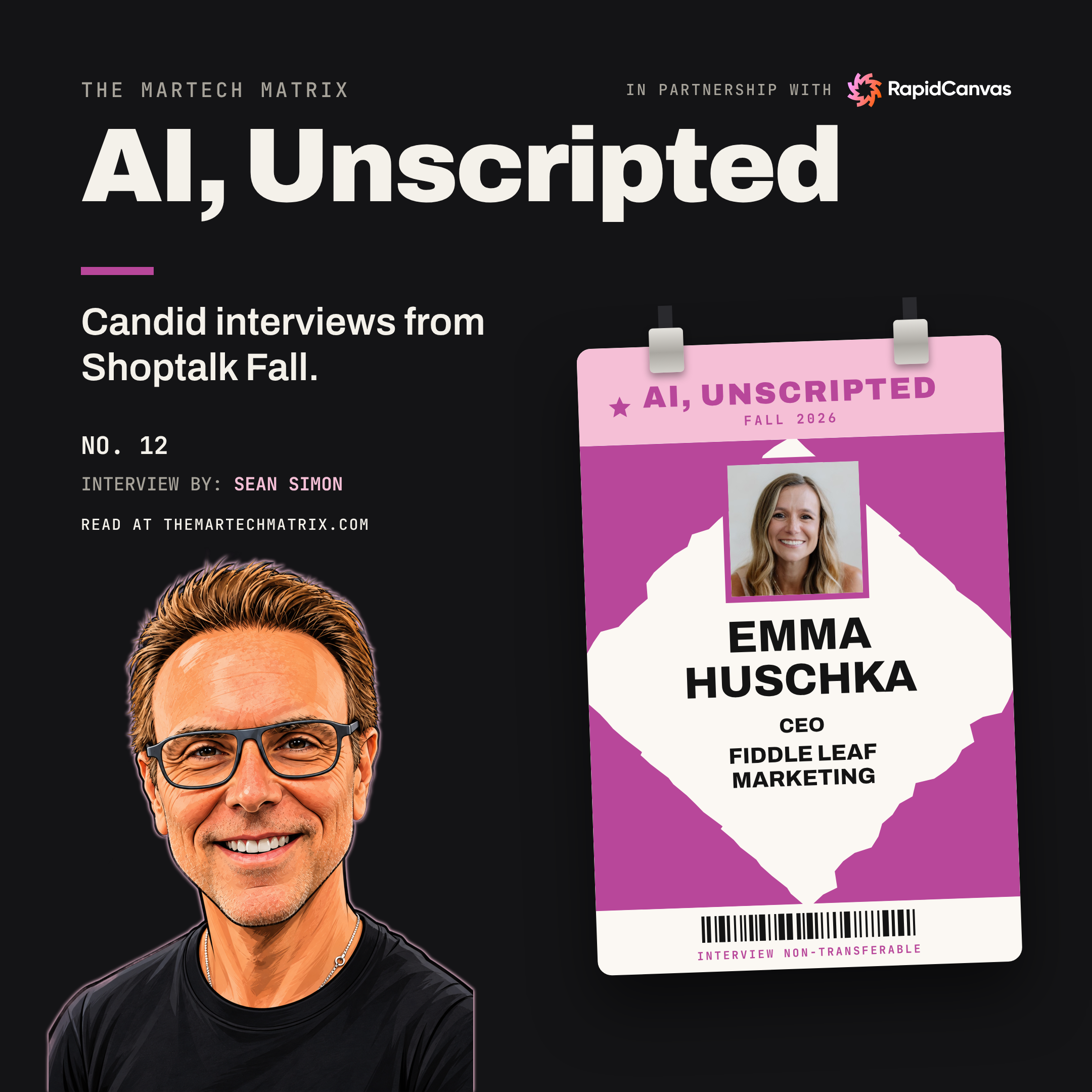
AI, Unscripted · No. 12 · Emma Huschka, CEO, Fiddle Leaf Marketing · Interview by Sean Simon at ShopTalk Fall ’26 · In partnership with RapidCanvas
AI for small agencies isn’t about replacing the team. It’s about getting hours back on onboarding, prospecting, email, and admin so a small shop can focus on the work clients actually pay for.
Emma Huschka is the founder and CEO of Fiddle Leaf Marketing, an agency that focuses on e-commerce brands — especially women-owned small and mid-sized businesses. About two and a half years into running the business, she’s also a mom of two toddlers, and she uses AI across nearly every part of her work and life.
At ShopTalk Fall ’26, Emma and Sean Simon traded practical examples of AI for small agencies: the tools that save her real time, where AI still falls short on creative, and her advice for marketers who feel behind.
Table of Contents
6 Practical Lessons on AI for Small Agencies
1. Automate the Back-and-Forth First
One of Emma’s biggest time savers is client onboarding. Instead of manually sending instructions for every platform her team needs access to, she vibe-coded an onboarding portal on her website. Clients log in, see exactly what access to grant, update progress, and ask questions in one place.
She also built her own prospecting tool. It finds women-owned e-commerce businesses, checks the Meta and Google ad libraries to see if they’re already advertising, and pulls their Instagram — turning a cold list into what she calls a warmer cold list. That’s AI for small agencies at its most practical: removing busywork, not judgment.
2. Let AI Draft Email — But Always Review
Emma uses Fyxer, an AI assistant connected to her inbox that drafts replies automatically. About half the time she can send with just a few tweaks. It wasn’t great at first, but after she taught it her tone and how she talks to clients — and gave it three to six months to learn from her edits — it became one of her biggest time savers.
Would she let it send without her review? Not yet. She still gives every draft a once-over — a good rule for anyone adopting AI for small agencies.
3. Creative Is Still the Delicate Part
The process Emma most wants to improve is creative: requesting ads from her creative strategist, sending them to clients, and managing revisions. It’s still manual, and representing a brand creatively is where client relationships are most sensitive. It’s also where AI for small agencies has the most room to grow.
On AI imagery, she’s transparent with clients and asks them to be honest about their comfort level. Some clients want to explore; others want to move slowly. She once used Claude to create an animated carousel featuring a pediatric dental office’s squirrel mascot, Pip, driving to its new location. It was a fun idea — and it didn’t perform. A good reminder that cool and effective aren’t the same thing.
If you’re not using it now, you’re going to get left behind.
Emma Huschka, Fiddle Leaf Marketing
4. AI UGC Could Level the Field for Small Budgets
The project Emma is most excited about is AI-generated user-generated content for clients with small budgets. UGC performs well, but many small businesses can’t afford to produce it. Her idea is to turn real customer testimonials into AI UGC-style video. For many clients, AI for small agencies could be the only realistic way to get that kind of content.
She acknowledges the ethical and transparency questions, and Sean raised a bigger one: what does authenticity even mean when the content is AI-generated? Both expect the answer to look different in six months.
5. Build Tools for Your Own Life
Emma’s go-to tool is Claude Code, while her team mainly uses ChatGPT. One of her favorite builds is Home Base, a personal app that merges her personal and professional schedules into one place with an AI assistant built in. She can ask it when she has time for lunch with a friend who’s moving, and it knows her whole calendar.
She also had Claude act as her CFO, building a financial health dashboard that shows trends, projections, and what she needs to do to protect margins. For a founder without a finance background, that’s AI for small agencies working where it’s needed most.
6. Just Start — and Ask the AI How to Use It
Emma’s advice for marketers who feel behind is simple: start using AI for everyday tasks, talk to people who already use it, and keep going. The more you use it, the more ideas you’ll have.
One of her most underrated tips: ask the AI itself. Tell it what you’re trying to solve, ask how it can help, and let it ask you questions. Talk to it like a person, she says — just remember at the end of the day that it’s AI.
Time is energy, energy is money. It’s all interconnected.
Emma Huschka, Fiddle Leaf Marketing
Related on The MarTech Matrix:
AI Isn’t Replacing Your Team. It’s Exposing What You Never Fixed.
About Emma Huschka and Fiddle Leaf Marketing
Emma Huschka is the founder and CEO of Fiddle Leaf Marketing, a digital marketing agency focused on e-commerce brands, with a particular focus on women-owned small and mid-sized businesses. Her agency manages paid media, creative, and client onboarding, and has grown largely through inbound referrals.
Emma is a heavy, hands-on AI user who builds her own tools with Claude Code, from client onboarding portals to personal scheduling apps and finance dashboards.
Frequently Asked Questions
How can small agencies use AI to save time?
Emma Huschka of Fiddle Leaf Marketing uses AI for client onboarding portals, prospect research, email drafting, and financial dashboards. Her advice is to start with repetitive back-and-forth tasks, like collecting platform access from clients, where AI saves time without replacing human judgment.
Should agencies let AI send client emails automatically?
Not yet, according to Emma Huschka. She uses Fyxer to draft replies and can send about half with minor tweaks, but she still reviews every message before it goes out. The tool improved significantly after several months of learning her tone.
How should agencies talk to clients about AI-generated creative?
Emma Huschka recommends full transparency. She tells clients how her agency uses AI, asks how they feel about it, and adjusts based on their comfort level — testing more with clients who are open and moving carefully with those who are hesitant.
What is the best way for a marketer to catch up on AI?
Start using it for everyday tasks, talk to people who already use it, and ask the AI itself how it can help. Emma Huschka says the more you use AI, the more ideas you’ll have for applying it to your work and life.


Leave a Reply