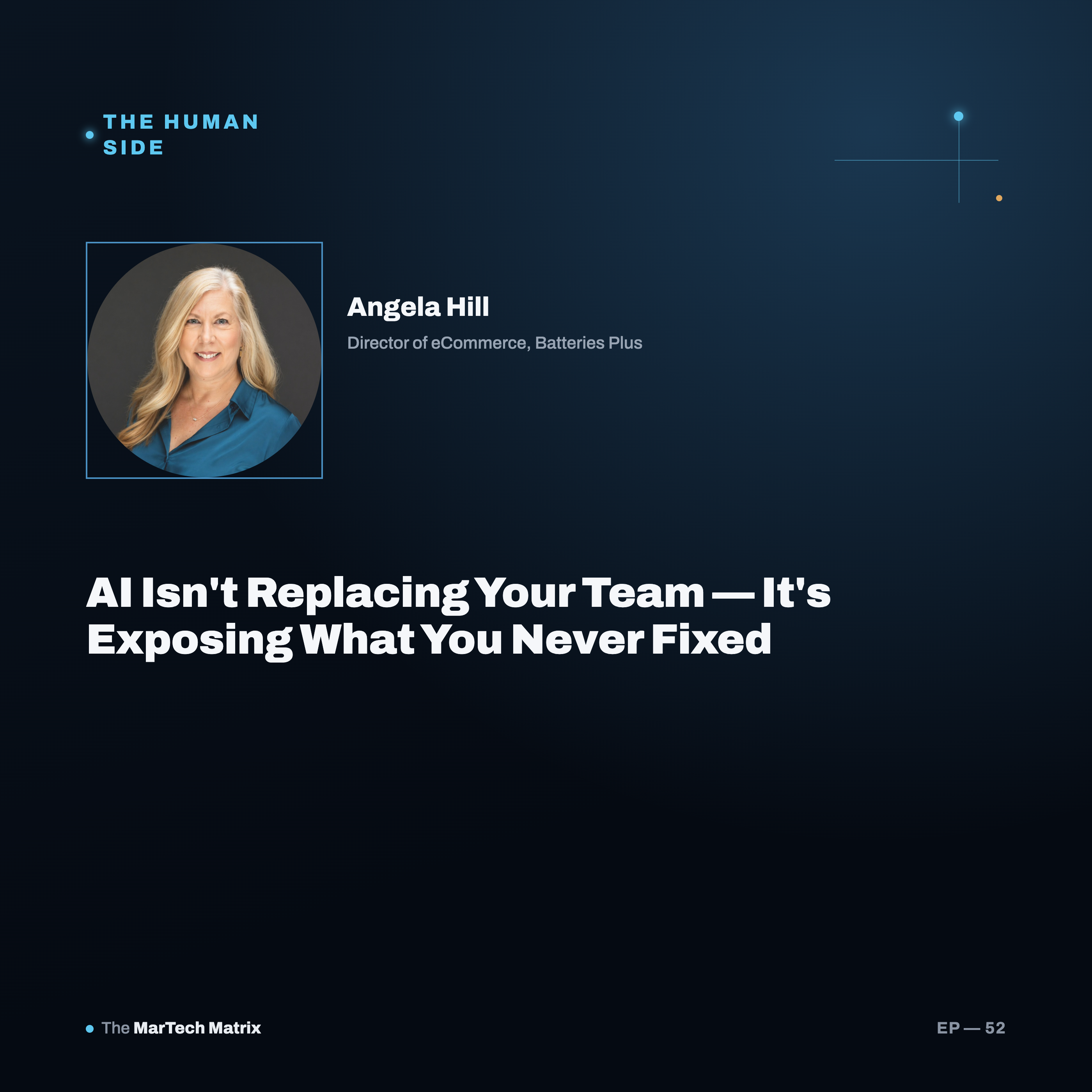
The Human Side of MarTech | Guest: Angela Hill, E-Commerce Leader, Batteries Plus
Table of Contents
AI Isn’t Replacing Your Team. It’s Exposing What You Never Fixed.
The big picture: Most companies are either racing to bolt AI onto everything or freezing because they don’t know where to start. Angela Hill, who runs e-commerce for Batteries Plus, has a simpler set of AI adoption lessons than most, her rule is: test it, use it if it solves a real problem, fire it if it doesn’t.
Hill has spent more than 20 years in e-commerce — enough hype cycles to be skeptical of the next one. In this episode of The Human Side of MarTech, she explains why AI is less a new capability than a mirror, exposing the messy data and undocumented processes companies have been ignoring for years. She also breaks down how she filters vendor pitches in a market that went from roughly 250 MarTech companies in 2010 to more than 20,000 today — AI adoption lessons that apply well beyond her own team.
Why it matters: If you’re evaluating AI tools or MarTech vendors right now, Hill’s framework is a working example of how to filter signal from noise — without either falling for the hype or getting left behind by it.
Why This Feels Overwhelming: 250 Vendors Became 20,000
In 2010, there were roughly 250 MarTech vendors to choose from. Today there are more than 20,000. Hill lived through that entire climb, and her read on it is blunt: you cannot evaluate this market from scratch anymore. “There’s just too many really to evaluate from scratch,” she said. “You can’t just go on a website and look — that doesn’t happen anymore. You’ll be stuck in Neverland doing that.”
Her workaround isn’t a tool. It’s a network. She leans on conferences like Shoptalk and ETail, peer conversations, and internal collaboration across departments to filter the noise before she ever takes a vendor meeting. “It’s why Amazon reviews became so popular,” she said. “Customers shop what other customers are buying. I think it’s becoming that now in this vendor world.”
Batteries Plus doesn’t have a formal AI governance policy yet, and Hill isn’t apologetic about that. The company is still figuring out what earns a permanent place in the stack versus what gets tried and dropped. That’s not indecision — it’s a deliberate, honest posture in a market moving faster than most governance processes can keep up with.
7 Best AI Adoption Lessons From Angela Hill
None of these AI adoption lessons are theoretical for Hill. It’s how she and her team actually operate day to day at Batteries Plus. Here’s the framework, in her own terms.
1. Get to 90% yourself, then let AI handle the last 10%
Hill’s standing instruction to her team: get everything to 90% on your own first. The remaining 10% — the part where you’re stuck, second-guessing yourself, or need a different angle — is where AI comes in. “We might go to AI to say, we really want to drive this point home and we can’t figure out exactly how to do it,” she said. It’s an assistant, not a replacement, and treating it that way keeps the team from outsourcing judgment it should be building itself.
2. Use AI to optimize what’s already working — not to reinvent it
Batteries Plus isn’t using AI to write all its copy or overhaul its processes overnight. It’s layered into tools the team already trusts: Microsoft Clarity and Google Analytics for reporting, Figma for design options, PMax for ads. “If we have those tools set up and it’s part of our process, why not use the AI that they’re bringing in?” Hill said. “We don’t need to replace.” Optimization, not reinvention, is the default lens.
3. Let AI expose the problems you’ve been avoiding
Hill’s sharpest observation: AI doesn’t create new problems — it exposes the ones companies already had. Messy data. Disorganized content. Search results that don’t work. “It’s gonna expose the issue of maybe your data is messy, and you need to fix your data because this is why your search results aren’t working,” she said. If AI or LLMs aren’t citing your site, it’s rarely an AI problem — it’s a structure, schema, and content problem that predates AI entirely.
4. Consolidate before you add another tool
When a new AI-powered tool shows up, Hill’s team doesn’t automatically bolt it on. They check whether an existing tool already does the job across departments first. “It’s not necessarily adding to it — it’s more of replacing maybe four tools with one really robust tool,” she said. She compares it to cleaning out a closet: five pairs of jeans that never get worn traded for the one you actually reach for.
5. Don’t roll out AI without addressing what it means for people
Hill is direct that AI at Batteries Plus isn’t about replacing people — it’s about eliminating repetitive work and speeding up processes so the team can focus on what actually needs a human. That distinction matters for adoption. Employees who understand AI is there to remove friction, not their job, engage with it differently than employees bracing for cuts.
6. Solve the business problem first — pick the AI angle second
“Finding that problem first and then thinking about it in terms of AI is sort of how we’re attacking it,” Hill said. It’s a small sequencing difference with a big effect: teams that start with “what should we do with AI” end up chasing capability. Teams that start with a real bottleneck and then ask whether AI helps end up with tools people actually use.
7. Keep the feeling — AI is good at optimal, not good at human
Hill’s litmus test for AI-generated copy: does it have a feeling behind it, or does it just sound optimal? “AI is like — elevate your car to the best optimal experience. What is that?” she said, contrasting it with copy that actually makes someone want something. Efficiency is table stakes. The brand voice and emotional pull still need a human hand.
Why Franchise E-Commerce Breaks the Standard Playbook
Most of the MarTech playbook assumes a typical e-commerce funnel. Batteries Plus doesn’t have one. It’s a franchise-first business — stores on the ground, e-commerce in a supporting role — and that changes what “success” means — along with which AI adoption lessons actually apply.
“Our website isn’t competing with our stores — it’s supporting them,” Hill said. An online order isn’t automatically a win if it should have driven someone into a store instead. Buy-online-pickup-in-store (BOPIS) is core to the model, and every decision has to account for both the customer and the franchise owner on the other end of that relationship.
The customer behavior compounds the challenge. Someone shopping Batteries Plus usually has a dead battery and no patience for a browsing experience. “They don’t have time to sit through ‘we think you might also like.’ They’re like, give me my battery and give me the one that fits,” Hill said. Standard product-recommendation and personalization playbooks, built for browsing behavior, often miss the point entirely for a business built on urgency.
The “Fitment” Test: How Angela Hill Filters Vendor Pitches
Hill’s first filter for any vendor pitch is simple: does this fit our customer and our business model? She uses “fitment” — the term for matching a battery to a specific vehicle — as her shorthand for the test. A vendor pitching generic product recommendations that ignore vehicle-specific fitment has already shown they didn’t do the homework.
“The vendor that’s gonna get our attention is the one that does their homework and understands the importance of the fitment. A lot of them try to sell on personalization and product recommendations, and then we kind of know — okay, you must not know our business.”
— Angela Hill
The vendors who break through lead with outcomes, not features. “We would love to hear what is the outcome that you’re trying to give to us versus the features that you offer,” Hill said. “Tell me the problem you’re solving, how quickly I’ll see the results, and how I can measure success.” She doesn’t want a dashboard walkthrough in a first meeting — she wants a conversation about her actual problem.
The Difference Between a Pitch That Wins Her Attention and One That Wastes Her Time
The vendors who get remembered are the ones who show up already knowing the business. Hill described walking a conference floor and having someone reference an actual visit to a Batteries Plus store — the clean location, the helpful employee, the battery they found fast. “That is a conversation starter for me that you just can’t replicate if you don’t know us,” she said.
Compare that to the vendors who scan a badge, ask “tell me what you do,” and move on before the conversation even starts — or the ones who book a meeting cold and get frustrated when it’s declined. “You haven’t even, you don’t even know who I am or what we’re looking for yet,” Hill said. Her estimate: about 20% of pitches are purely salesy. The rest earn their spot through research, even when a deal never materializes.
One vendor stuck with her specifically because they didn’t force a sale. “Listen, I know we can’t do business with you right now, but what scenario in the future could we potentially do business with you?” she recalled one saying. That’s the kind of specificity — and patience — that actually earns a callback later.
What an “AI-Native” Hire Actually Looks Like
Asked what she looks for in an “AI-native” hire — a phrase that’s become a hiring buzzword despite the tech being mainstream for barely two years — Hill’s answer circled back to the same 90/10 framework she applies to her team’s own work. She wants people who can do the job on their own and know when AI genuinely adds something on top of that. “If you can work with us on the ninety percent, and then on the ten percent provide that additional expertise, I think that would be ideal,” she said.
What she doesn’t want to lose is the brainstorming and ideation that makes her team distinct. AI fluency matters, but not at the cost of the human judgment that got Batteries Plus this far.
The Bottom Line
Hill’s approach isn’t a rejection of AI — she’s using it across reporting, design, customer service, and internal workflow. Her AI adoption lessons boil down to one discipline: prove it solves a real problem for your specific business before it earns a permanent place in your stack. That discipline is exactly what a market of 20,000 vendors is testing every buyer’s ability to hold onto.
For vendors, the lesson is just as direct: know the business before you pitch it, lead with the outcome, and don’t assume your solution to a typical e-commerce problem automatically applies to a franchise-first, use-case-driven business like Batteries Plus.
How should e-commerce companies actually adopt AI?
Angela Hill of Batteries Plus shares AI adoption lessons built on a test-first approach: identify a real business problem first, then evaluate whether AI is the right solution. Test the tool, use it if it solves the problem, drop it if it doesn’t.
Why is the MarTech vendor market so hard to evaluate today?
Vendors grew from roughly 250 in 2010 to more than 20,000 today, making it impossible to evaluate from scratch. Buyers rely on peer networks, conferences, and word-of-mouth instead.
What makes a vendor pitch stand out to an experienced e-commerce buyer?
Vendors who do homework on the specific business get her attention immediately — leading with the outcome, not features, and explaining how quickly results show up.
Why do standard e-commerce personalization strategies fail for franchise businesses?
Franchise-first businesses support stores rather than compete with them, so an online order isn’t automatically the goal, and standard playbooks built for browsing don’t fit urgent-need customers.
If you’re applying Hill’s AI adoption lessons to your own shortlist of vendors, check out Blurbs to compare options without the buzzwords — and build your own version of the fitment test.
Subscribe to The Human Side of MarTech on Spotify, Apple Podcasts, or wherever you listen. New episodes weekly.

More Conversations on The MarTech Matrix

Your MarTech Stack Is Failing Quietly — Here’s How Enterprise Teams Fix It
The Human Side of MarTech

Evaluating MarTech: Insights from a DTC Operator
The Human Side of MarTech

Best Enterprise AI Data Integration Tips
Inside the Blurb



Leave a Reply