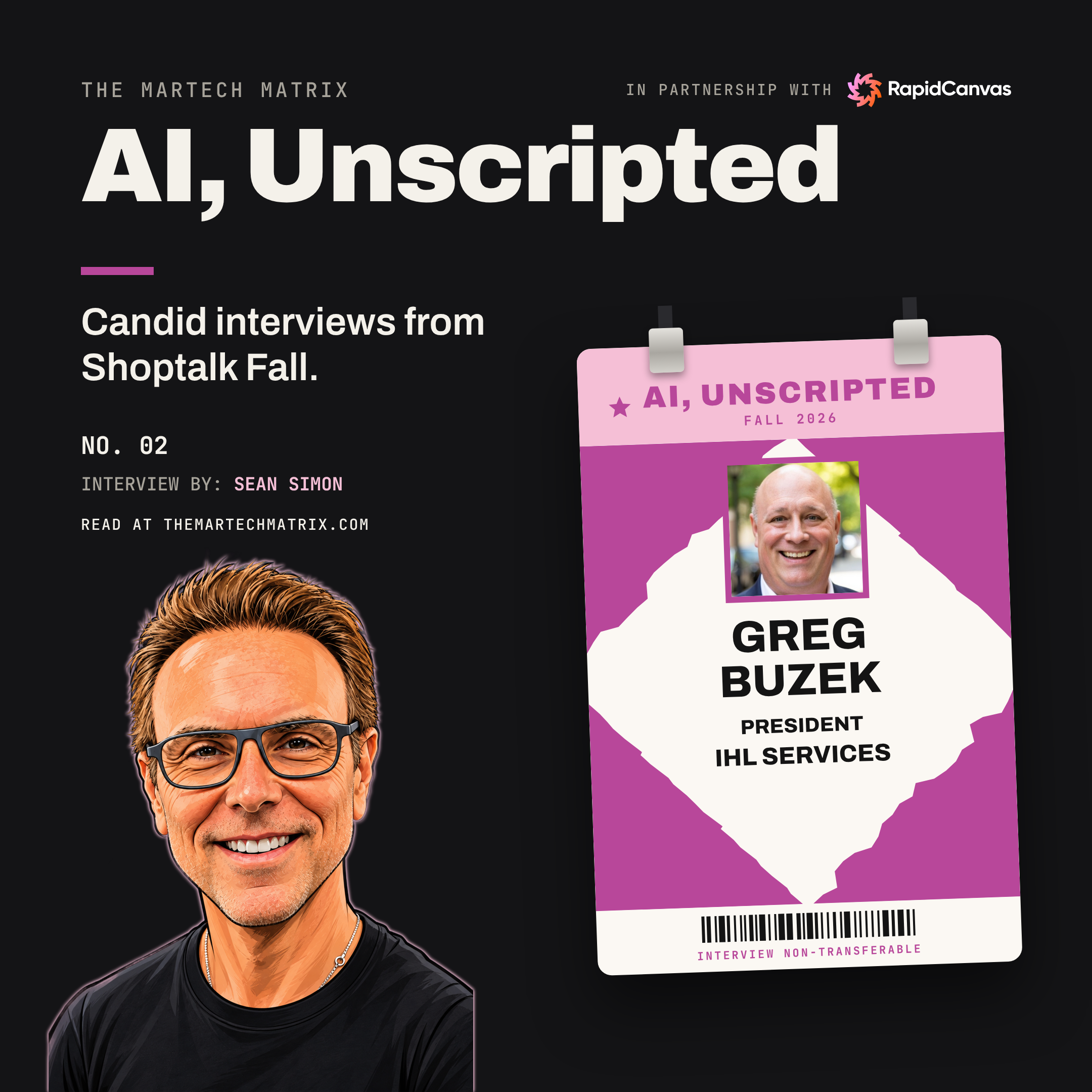
AI, Unscripted · No. 02 · Greg Buzek, President, IHL Services · Interview by Sean Simon at ShopTalk Fall ’26 · In partnership with RapidCanvas
Retail AI readiness has very little to do with which AI tool you buy. According to Greg Buzek, it comes down to whether your data, your store network, and your website are ready for AI in the first place — and most retailers aren’t.
Greg is the president and founder of IHL, the retail technology analyst firm he started in 1996. His team counts point-of-sale terminals, tracks store footprints, and runs a data service called SOFIA that monitors 300 technologies installed at retailers around the world. Few people have watched retail tech evolve longer, and at ShopTalk Fall ’26 he told Sean Simon exactly where the industry stands.
His verdict on retail AI readiness: a small group of retailers pulled ahead years ago, and everyone else is stuck in traffic.
Table of Contents
6 Retail AI Readiness Lessons From 30 Years of Tracking Retail Tech
1. The Leaders Separated in 2018 — Not in 2023
Greg traces today’s AI gap back to 2018, when Amazon broke out its retail business and showed it was profitable. A group of roughly 15 to 20 retailers realized they were in an IT race. They stopped tying IT budgets to revenue growth and increased IT spend by roughly 40 to 50 percent a year for four to five years.
That investment paid off twice. When COVID hit, those retailers already had things like contactless payments in place. Now that AI is here, they already have the clean, centralized data AI depends on. That’s retail AI readiness built years in advance.
If the goal was to get to LaGuardia Airport from Times Square, these guys are already through the tunnel, through the toll booth, on the Long Island Expressway. Most retailers are stuck between Seventh and Eighth in bumper-to-bumper traffic.
Greg Buzek, IHL
2. AI Is a Recipe, Not a Technology
Greg’s framework for retail AI readiness has a clear order. First, clean, accurate data with a single view of the truth — including accurate store inventory. Second, a store network that can actually support the robots, IoT devices, electronic shelf labels, and digital signage that generate and use that data. Only then can a retailer decide which direction to take AI.
Skip the first two steps and you’re in trouble. Most retailers, he says, are still cleaning their data.
3. The Store Is Still the Center of Retail
Even with all the attention on digital, the store remains the distribution point. According to IHL data, about 89 percent of orders touched a store in some way last year, even though only about 45 percent were actually placed in a store. Buy online, pick up in store, click and collect, and local delivery all run through physical locations — which is why store infrastructure is part of retail AI readiness.
4. If Agents Can’t Read Your Site, You’re Invisible
The gap that worries Greg most: most retailers haven’t optimized their websites for AI agents to shop them. He learned this firsthand when an AI tool told him IHL’s site had no FAQs — even though it did. They just weren’t formatted in a way the agent could read.
At a recent conference with specialty retailers, he found that not a single one had optimized their site for agents. With consumer agents like Meta’s Muse entering the market, that means they’re invisible unless a shopper asks for them by name. It’s the reason Greg is turning what started as an April Fool’s joke — Retail AgentCon — into a real virtual event on November 17 focused on how retailers work with agents.
5. Put Guardrails on AI Before You Trust It
AI has transformed IHL’s own research. Finding the right stories in a study used to take Greg about four days to surface around 125 good ones. Now he gets 1,300 to 1,400 candidates in about five minutes, and editing down takes about an hour. IHL has also added close to a million data points in six months using AI-driven research.
But he learned to build guardrails the hard way. Early on, an AI tool gave him a perfect CIO anecdote — then admitted it made the whole thing up. Now every statement carries a confidence score: 100 if it came straight from his own material, 80 if inferred from it, 70 if it came from a reputable source, and anything lower gets cut.
You gotta do the work to teach the AI how to write like you.
Greg Buzek, IHL
6. A Small Team Can Run Like a Big One
IHL has five full-time employees and 25 AI agents. Greg named each one after a famous character so he can remember who does what — Thomas Edison handles research, Donna from Suits is his admin, Harvey does legal, and his chief of staff is named Top. He even vibe-coded a dashboard to track which tasks the agents are waiting on him to finish.
His bigger prediction is about people, not tools. The pace of change is so fast that he expects a consumer backlash toward simplicity — fewer touch points, less noise. Retail AI readiness, in other words, isn’t just a technology problem. It’s also about not overwhelming the customer.
Related on The MarTech Matrix:
AI Isn’t Replacing Your Team. It’s Exposing What You Never Fixed.
About Greg Buzek
Greg Buzek is the president and founder of IHL, a retail technology research and advisory firm he launched in 1996. He’s attended NRF more than 30 times. Before IHL, he worked at NCR as a competitive intelligence lead and product manager — where he helped introduce Wi-Fi into retail for JCPenney — and later at Sensormatic Electronics.
IHL’s SOFIA data service tracks 300 technologies across retailers worldwide, including install dates, replacement cycles, and key decision-makers, and is used by technology vendors, retailers, private equity firms, and consulting groups.
Frequently Asked Questions
What does retail AI readiness mean?
Retail AI readiness is a retailer’s ability to actually benefit from AI. According to Greg Buzek of IHL, it starts with clean, accurate data and a single view of the truth, followed by a store network that can support connected devices. Only after those foundations are in place can a retailer deploy AI effectively.
Why are some retailers ahead on AI?
Greg Buzek says a group of about 15 to 20 retailers separated themselves around 2018, after Amazon’s retail business showed a profit. They decoupled IT spending from revenue growth and invested heavily for several years, which gave them clean data and modern infrastructure that now supports AI.
How can retailers make their websites visible to AI shopping agents?
Retailers need to structure their site content so agents can read it — including properly formatted FAQs and answers to the questions shoppers are likely to ask. Greg Buzek notes that if this information isn’t on the page in the right format, retailers are effectively invisible to agents unless a shopper asks for them by name.
How does IHL use AI in its own research?
IHL uses AI to find stories in survey data and to expand its SOFIA database, adding close to a million data points in six months. Greg Buzek applies confidence scores to every AI-generated statement and removes anything that can’t be traced to his own material or a reputable source.



Leave a Reply