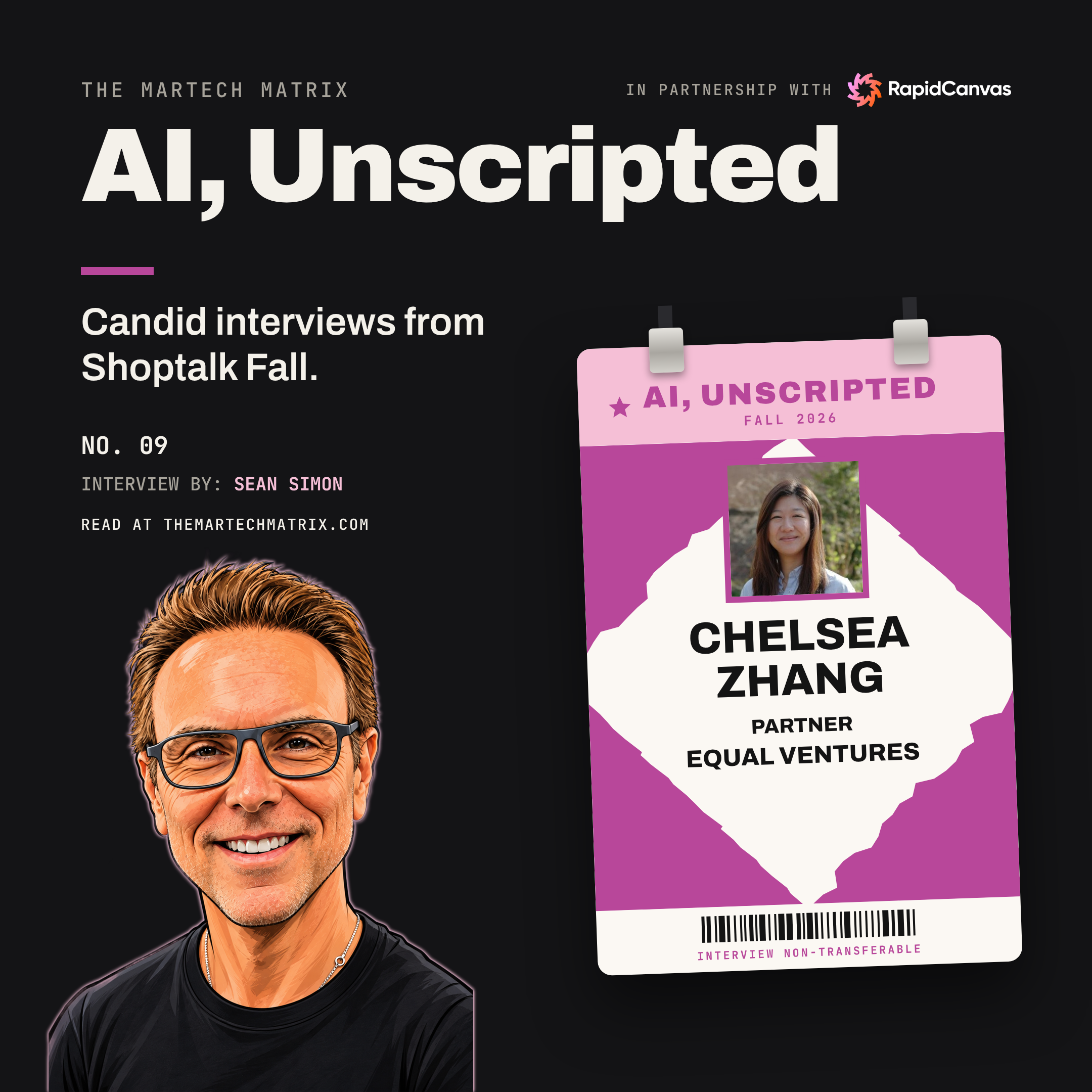
AI, Unscripted · No. 09 · Chelsea Zhang, Partner, Equal Ventures · Interview by Sean Simon at ShopTalk Fall ’26 · In partnership with RapidCanvas
Agentic commerce came up in nearly every conversation at ShopTalk Fall ’26. But according to Chelsea Zhang, the first wave of hype didn’t play out the way many predicted — and the next one might look very different.
Chelsea is a partner at Equal Ventures, where she leads the firm’s commerce enablement investing. She spends her days talking with startup founders, brand-side technology buyers, innovation partners at companies like Shopify and Amazon, and operators across the value chain, from 3PLs to freight forwarders.
In this interview, she and Sean Simon discussed where brands really are on AI, why Meta’s Muse launch changed the agentic commerce conversation, why AI may not transform how large companies run, and what she looks for in founders right now.
Table of Contents
6 Agentic Commerce Truths From a Commerce VC
1. Brand Size Changes Everything
Chelsea sees two very different buyer profiles. Digitally native Shopify brands tend to have more modern infrastructure and move quickly, but a new solution has to clear a high bar to be worth their time. Large legacy brands often have messy technology underneath a great consumer brand, making adoption harder — but even an incremental improvement can have massive impact at their scale.
She also sees a lot of what she calls fear-based buying, especially the rush into AEO and GEO as brands worry about how agentic commerce will affect discovery.
2. Agentic Commerce 1.0 Didn’t Pan Out
The first hypothesis — that mainstream consumers would start buying everything through ChatGPT — hasn’t happened. Chelsea notes that some early retailers pulled back on investments because they weren’t seeing conversions through that channel.
What the data does show is consumers using AI to research and influence purchases. The transaction itself is still happening elsewhere.
3. Meta’s Muse Made Retail CEOs Sit Up
What changed recently, in Chelsea’s view, is Meta launching Muse, a consumer AI agent that already has context on its users and the distribution to reach almost everyone. That’s why she believes the AI labs have started taking agentic commerce more seriously in recent weeks.
She’s also watching Meta’s AI glasses, which move the battery to a separate pack so the frames look and wear like normal glasses. Whether it’s glasses or something else, she expects some kind of wearable that sees what you see to become the consumer agent’s home. Because Meta has historically stayed out of the transaction layer, many retailers may welcome it as a net-new sales channel.
If Meta can use their distribution to actually launch a true consumer-grade horizontal agent, I think the promise of agentic commerce is much closer.
Chelsea Zhang, Equal Ventures
4. AI Won’t Fix How Large Organizations Run
Chelsea’s personal view: AI changes a lot, but it doesn’t change the reasons enterprise technology succeeds or fails — implementation, stakeholder buy-in, and process. The biggest wins she sees come from AI features built on top of software a company already uses, where the data is already structured and clean.
She even thinks AI agents could make some ERP systems stickier, since humans won’t need to interact with them directly anymore. Successful pilots start with one clear KPI and a scoped process. And while AI search can tolerate a less-than-perfect answer, many enterprise use cases need 100 percent accuracy.
5. Emerging Brands Have a First-Mover Window
Rather than DTC versus traditional, Chelsea frames the opportunity as emerging versus established brands. Like the early days of SEO, new AI surfaces give emerging brands a chance to get ahead while everyone starts from close to zero.
She also expects AI shopping to be functional and research-heavy, which creates a new opening for discovery and joy — through community, real life, and creator-driven channels. The most sophisticated merchants are already thinking about speaking to agents and humans differently, and she believes incumbents like Shopify, with infrastructure and data across many brands, are likely to be net winners of agentic commerce.
6. The Best Founders Move Fast and Stay Patient
With the market this choppy, Chelsea says the team matters more than ever. She looks for founders who understand the customer, move quickly on technology, and accept that some of what they build may be obsolete in a month — while keeping their eye on the bigger vision.
It’s a mindset shift from traditional SaaS. Several founders at the show told her the market had tipped in their favor in just the past month or two, which makes her optimistic about the next few quarters for agentic commerce and the companies enabling it.
Related on The MarTech Matrix:
Reddit Marketing Strategy: Most Brands Don’t Have One But Should Before They Fail
About Chelsea Zhang
Chelsea Zhang is a partner at Equal Ventures, where she leads the firm’s commerce enablement investing. Her work combines meeting founders building in commerce, logistics, and supply chain with ongoing market research across brands, platforms like Shopify and Amazon, 3PLs, and freight forwarders.
She focuses on how new technology, including AI agents, is reshaping every layer of commerce, from infrastructure to applications.
Frequently Asked Questions
What is agentic commerce?
Agentic commerce refers to shopping that is researched, recommended, or completed by AI agents on a consumer’s behalf. According to Chelsea Zhang of Equal Ventures, consumers today mostly use AI for research and influence, while actual transactions through AI agents have not yet scaled.
Why didn’t the first wave of agentic commerce take off?
The early hypothesis that mainstream consumers would buy everything through tools like ChatGPT didn’t materialize. Chelsea Zhang notes that some retailers who invested early pulled back because they weren’t seeing conversions through that channel.
How does Meta’s Muse affect agentic commerce?
Chelsea Zhang believes Meta’s Muse agent is significant because Meta already has context on its users and reaches nearly every consumer. That combination of context and distribution makes a true consumer-grade AI shopping agent more realistic, which is why she says AI labs and retail CEOs are now taking agentic commerce more seriously.
Which brands benefit most from agentic commerce?
Chelsea Zhang sees an opportunity for emerging brands, similar to early SEO, because new AI surfaces let them compete before established players optimize. She also expects incumbents with deep infrastructure and data, such as Shopify, to be net winners.



Leave a Reply