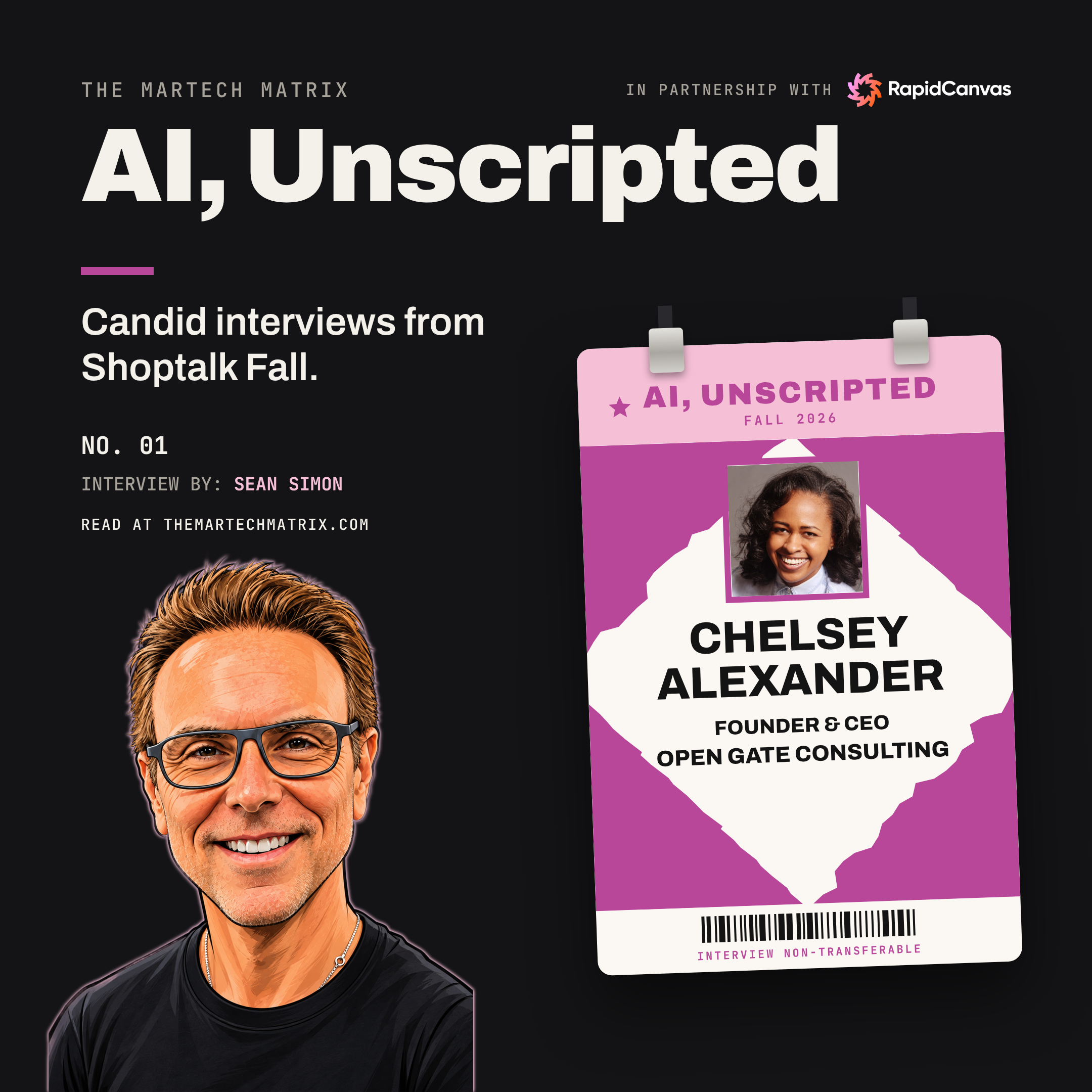
AI, Unscripted · No. 01 · Chelsey Alexander, Founder & CEO, Open Gate Consulting · Interview by Sean Simon at ShopTalk Fall ’26 · In partnership with RapidCanvas
A marketplace brand strategy used to be a side conversation. Now it sits at the center of how consumers actually buy — on Amazon, DoorDash, Instacart, TikTok Shop, and everywhere in between. And the hardest part isn’t the tech. It’s letting go of the idea that you control the customer.
Chelsey Alexander is the founder and CEO of Open Gate Consulting and a former P&G marketer. She moderated a ShopTalk Fall ’26 panel on brand strategies in marketplaces, and she sat down with Sean Simon right after to talk about control, loyalty, delivery speed, and why the old funnel doesn’t describe how people shop anymore.
It’s a short interview with a big idea at the center: nobody owns the customer. The brands that win are the ones that show up wherever the customer is ready to buy — and give them a real reason to come back. That’s the core of a marketplace brand strategy that works in 2026.
Table of Contents
5 Marketplace Brand Strategy Takeaways
1. Control Is Partly an Illusion
The elephant in every marketplace conversation is control. When you sell through a marketplace, you give up some say over how your product is presented and who owns the customer data. Chelsey’s point: you can argue about brand equity in an office all day, but brand equity doesn’t matter if people aren’t buying.
She also made a practical observation that a lot of brands miss. Third-party sellers are probably already selling your products. So the real question for any marketplace brand strategy is how your brand looks on those platforms today — and whether you can make it look better than the bad actors do.
2. Draw a Box Around What You Won’t Negotiate
Not every concession is acceptable. Chelsey highlighted how Sharon Leite, CEO of The Vitamin Shoppe, described her approach on the panel: draw a box. Inside the box are the things you accept because you understand how marketplaces work. Outside the box are the things you won’t do, even if it costs you the sale.
That’s a useful frame for any marketplace brand strategy. Decide your non-negotiables up front — product safety, pricing floors, brand presentation — and be flexible on everything else.
Ultimately you have to be where the consumer is thinking about making a purchase. That’s the name of the game.
Chelsey Alexander, Open Gate Consulting
3. The Funnel Has Collapsed Into a Race to Commerce
Many organizations are still structured around awareness, interest, consideration, action, and loyalty as separate stages owned by separate teams. Chelsey argues that’s not how it works anymore. Discovery and purchase are happening in the same moment, especially on social commerce platforms like TikTok Shop, where an influencer, a coupon, and a checkout button live in one place.
Her prediction is simple: the future is a race to commerce. A modern marketplace brand strategy finds the audience wherever they are, then gets them to conversion as quickly as possible.
4. Nobody Owns the Customer — Build Compounding Relationships Instead
Sean and Chelsey agreed that loyalty is getting harder to earn when a cheaper or faster option is always one tap away. Chelsey’s answer isn’t to give up on loyalty. It’s to focus on what she calls compounding relationships: reasons for a customer to keep engaging with you over time.
She pointed to her P&G days, where the Pampers Rewards program became one of the brand’s most valuable marketing assets. It wasn’t really about diapers. It was a relationship with parents built on useful information throughout the child’s early years. Retailers need the same kind of point of difference — whether that’s experience, efficiency, or something else customers value. A marketplace brand strategy without that point of difference is just a listing.
We all own it. Brands have to have their unique point of difference from a consumer lens. Retailers have to have their own point of difference from the consumer lens.
Chelsey Alexander, Open Gate Consulting
5. Speed, Price, and Experience Are the New Battlegrounds
Sean brought up Lowe’s testing drone delivery for small items in North Carolina. Chelsey sees delivery speed as a growing part of marketplace brand strategy and one of the clearest ways to stand out: two-day shipping is now the baseline expectation, and some shoppers expect one day or less.
She also believes price is a major factor given current economic pressure — but that people will still spend on experiences that feel worth it. Her example: TikTok Shop livestreams from brands like Mary Ruth’s, which feel like a modern version of QVC. It won’t work for every category, but for the right brand it’s a real way to stand out. As for agentic shopping, Chelsey doesn’t expect it to matter at scale this holiday season. Price will matter more.
Related on The MarTech Matrix:
About Chelsey Alexander
Chelsey Alexander is the founder and CEO of Open Gate Consulting, which helps brands navigate commerce strategy across retail and marketplaces. She spent years at P&G before launching her firm. At ShopTalk Fall ’26 she moderated a panel on brand strategies in marketplaces, covering third-party platforms and last-mile marketplaces like DoorDash and Instacart.
Inside her own business, she uses AI mainly to keep branded materials consistent — and like many founders, she’s weighing whether AI agents could take on operational work before she makes her next hires.
Frequently Asked Questions
What is a marketplace brand strategy?
A marketplace brand strategy is a plan for how a brand shows up and sells on third-party platforms like Amazon, Walmart Marketplace, DoorDash, Instacart, and TikTok Shop. It covers how the brand is presented, which sellers it works with, pricing and content standards, and which trade-offs it will and won’t accept in exchange for reaching customers where they buy.
How should brands handle losing control on marketplaces?
Chelsey Alexander recommends accepting that some control is an illusion — third-party sellers may already be selling your products. Brands should decide their non-negotiables up front, a practice Sharon Leite of The Vitamin Shoppe calls drawing a box, and be flexible on everything else so they can be present where customers make purchase decisions.
Is customer loyalty still possible when shoppers have endless options?
It’s harder, but not impossible. Rather than relying on traditional loyalty, Chelsey Alexander suggests building compounding relationships — ongoing reasons for customers to engage, like the Pampers Rewards program at P&G — and giving shoppers a clear point of difference in experience, speed, or value.
Will agentic shopping change marketplace strategy this holiday season?
Chelsey Alexander doesn’t expect agentic shopping to have a major impact at scale this holiday season. She believes most mainstream consumers aren’t there yet, and that price will matter more to retailers and brands in the near term given economic pressure.



Leave a Reply